Turbocharger
EngineAn exhaust-driven turbine spins a compressor that packs more air into the engine, so a small engine makes the power of a larger one.
Found on: Cars · Trucks
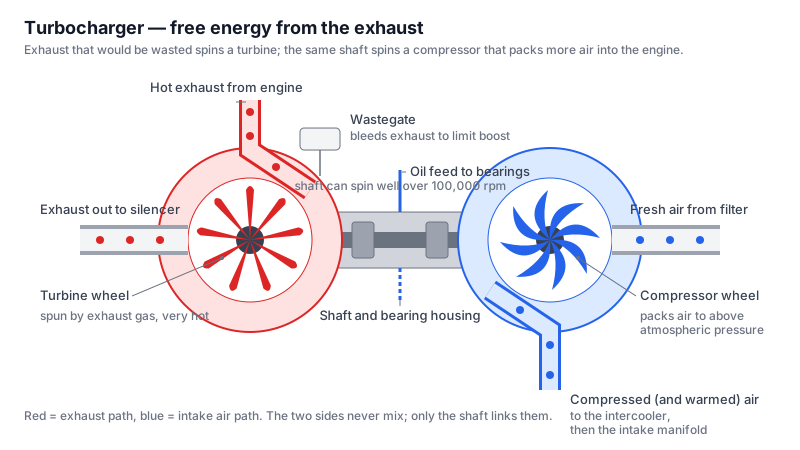
Cross-section: exhaust (red) spins the turbine, the shared shaft spins the compressor, and compressed air (blue) goes to the intercooler and engine. 
Sectioned Garrett turbocharger from a diesel engine: turbine and compressor wheels on their shared shaft.Photo: Tommi Nummelin · CC BY-SA 3.0 · Commons Engineering Explained: how turbochargers work.Video: Engineering Explained
How it works
An engine makes power by burning air and fuel; the more air you can fit into each cylinder, the more fuel you can burn. A turbocharger forces extra air in using energy that would otherwise leave through the exhaust pipe. It is two fans on one shaft, separated by a bearing housing fed with engine oil. On the hot side, exhaust gas rushes through a snail-shaped housing and spins a turbine wheel. On the cold side, the compressor wheel on the same shaft draws in filtered air and squeezes it. The compressed, warmed air passes through an intercooler (a radiator for air) and then into the intake manifold at above atmospheric pressure, known as boost.
- Exhaust leaves the cylinders and spins the turbine.
- The shaft spins the compressor at very high speed.
- Compressed air is cooled in the intercooler and enters the engine.
- A wastegate opens to let exhaust bypass the turbine once the target boost is reached.
Nearly every modern diesel is turbocharged, from a Tata Ace to a Tata Prima truck, and the Nexon, Venue, Sonet and Taigun turbo-petrols show how the technology lets a 1.0 or 1.2-litre three-cylinder replace a 1.5-litre engine while cutting tax and fuel use. What the driver feels is a surge once the turbine has spooled up, and a slight pause, turbo lag, when flooring the pedal from low revs. Twin-scroll housings and variable-geometry turbines reduce this. Turbos run very hot and spin on a thin oil film, so regular oil changes and a short idle after a hard run matter more than on a naturally aspirated engine.
Pros
- More power and torque from a smaller, lighter engine
- Better efficiency at part load
- Uses exhaust energy that is otherwise wasted
Cons
- Turbo lag at low revs
- Extra heat and complexity; sensitive to oil quality
- Dearer to repair out of warranty
Vehicles with this component
30 models on sale or coming. The note after the price is what the spec sheet says about this component; a variant name in brackets means only that trim brings it.
Cars 22
 Hyundai Alcazar₹14.5 lakh – ₹21.24 lakhPhoto: Hindi DriveSpark · CC BY 3.0 · Wikimedia CommonsLaunched 1 Sept 2024launched
 Hyundai Creta(SX(O) 1.5 Turbo DCT variant)₹10.73 lakh – ₹19.7 lakhPhoto: RL GNZLZ · CC BY-SA 4.0 · Wikimedia Commons


