Air cooling
EngineCooling fins on the cylinder and head pass engine heat straight to the air flowing past; simple, light and cheap.
Found on: Motorcycles · Scooters
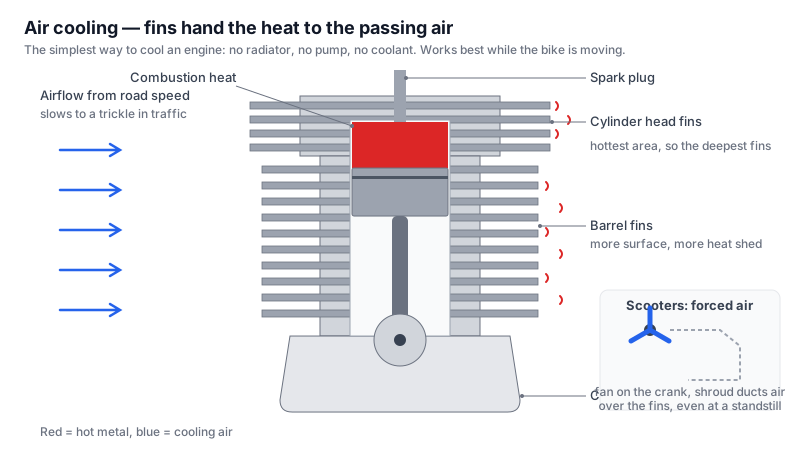
Heat flows from the combustion chamber into the fins and away with the passing air; scooters add a fan and shroud for forced air. 
Deep cooling fins on the head and barrel of a single-cylinder air-cooled motorcycle engine.Photo: Yanko Malinov · CC BY-SA 4.0 · Commons PowerDrift's simplified explainer of air, oil and liquid engine cooling on Indian bikes.Video: PowerDrift
How it works
Every engine wastes much of its fuel as heat, and the metal around the combustion chamber would soften or seize if that heat were not carried away. Air cooling is the simplest answer. The cylinder barrel and head are cast with deep fins that multiply the surface exposed to the air; heat conducts from the chamber wall into the fins and the airstream carries it off. There is no radiator, pump, hoses or coolant to fail or top up, which is why the Hero Splendor, Honda Shine, Bajaj Platina and most Indian commuter bikes under 160 cc use it.
- Combustion heats the cylinder head and bore.
- Heat conducts outward into the fins.
- Air moving past the fins picks up the heat; the faster the bike, the more cooling.
- The engine oil also carries some heat down to the crankcase.
The weakness is obvious at a traffic signal in May: with no airflow the engine temperature climbs, and the design has to leave enough margin to survive it. Scooters solve this with forced air cooling: a fan on the crankshaft blows air through a plastic shroud over the fins, which is why a TVS Jupiter or Honda Activa does not mind crawling in traffic. Riders notice an air-cooled engine's slightly looser mechanical note and, on hot days, a drop in performance and a tendency to run hot. Because the temperature swings more than on a liquid-cooled engine, tolerances are set looser and the tune is conservative; this limits how much power a given displacement can safely make, so sportier bikes move to oil or liquid cooling.
Pros
- Simplest and cheapest: nothing to leak or top up
- Light and compact
- Easy to service anywhere in India
Cons
- Runs hot in traffic and in summer
- Limits power output for a given engine size
- Noisier, with a looser mechanical note
Vehicles with this component
40 models on sale or coming. The note after the price is what the spec sheet says about this component; a variant name in brackets means only that trim brings it.
Motorcycles 28
- Bajaj Auto Freedom 125₹1.04 lakh – ₹1.17 lakhLaunched 1 Jul 2024launched
 Bajaj Auto Pulsar 180₹1.22 lakhPhoto: බිඟුවා · CC BY-SA 3.0 · Wikimedia CommonsLaunched 1 Jul 2023launched


