Diesel engine
EngineA compression-ignition engine that squeezes air until it is hot enough to ignite injected diesel; strong at low revs and frugal.
Found on: Cars · Trucks
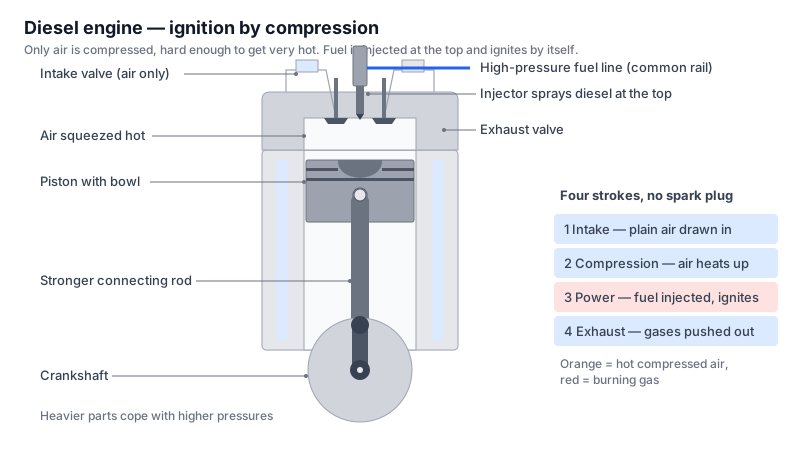
Compression ignition: only air is compressed, then diesel is injected at the top and lights without a spark plug. 
Cutaway of a MAN truck diesel engine: pistons in their cylinders with the common-rail injectors above them.Photo: Olivier Cleynen · CC BY-SA 3.0 · Commons Shell's animation of how a diesel engine works.Video: Shell
How it works
A diesel engine looks like a petrol engine inside, with pistons, valves and a crankshaft, but it has no spark plugs. It relies on heat from compression instead. Only air is drawn in, and the piston squeezes it to a much higher compression ratio than a petrol engine would tolerate; the air becomes hot enough to light diesel the moment it appears. A fuel injector at the top of each cylinder then sprays a fine mist straight into the chamber, timed by the engine control unit.
- Intake: air alone enters through the open valve.
- Compression: the air is compressed hard and becomes very hot.
- Power: diesel is injected at very high pressure (common rail) and burns as it mixes; the pressure pushes the piston down.
- Exhaust: the burnt gas leaves, in most modern diesels through a turbocharger before the silencer.
Because combustion is controlled by how much fuel is injected rather than by a throttle, and because the compression ratio is high, a diesel extracts more energy from every litre. Diesel also carries more energy per litre than petrol. The result is the strong low-rev pull that owners of a Scorpio-N, Innova Crysta or Fortuner notice, and the high mileage of small diesels like the Nexon or Venue. The trade-offs are heavier internal parts to cope with the pressures, more noise and vibration, a higher purchase price, and an exhaust system with a particulate filter and SCR catalyst that needs the engine to warm up properly to stay clean. Virtually every truck and bus in India is a diesel; no two-wheeler sold here is.
Pros
- Excellent fuel efficiency, especially on long runs
- Strong low-rev torque for loads and hills
- Diesel is cheaper per litre than petrol in India
Cons
- Noisier, with more vibration than petrol
- Costs more to buy and to service
- Emission hardware (DPF, SCR) suits highway use better than short city hops
- Ten-year life limit for diesels in Delhi NCR
Vehicles with this component
120 models on sale or coming. The note after the price is what the spec sheet says about this component; a variant name in brackets means only that trim brings it.
Cars 44
 BMW 3 Series Gran Limousine(320Ld M Sport variant)₹60.45 lakh – ₹61.75 lakh · 187.4 bhpPhoto: LuvsMG481 · CC BY-SA 4.0 · Wikimedia CommonsLaunched 10 Jan 2023launched
 BMW X3(xDrive20d M Sport variant)₹71.2 lakh – ₹73.1 lakh · 194.3 bhpPhoto: Retired electrician · CC0 · Wikimedia Commons


