Liquid cooling
EngineCoolant pumped through jackets around the cylinders carries heat to a radiator, holding the engine at a steady temperature whatever the traffic.
Found on: Cars · Motorcycles · Scooters · Trucks
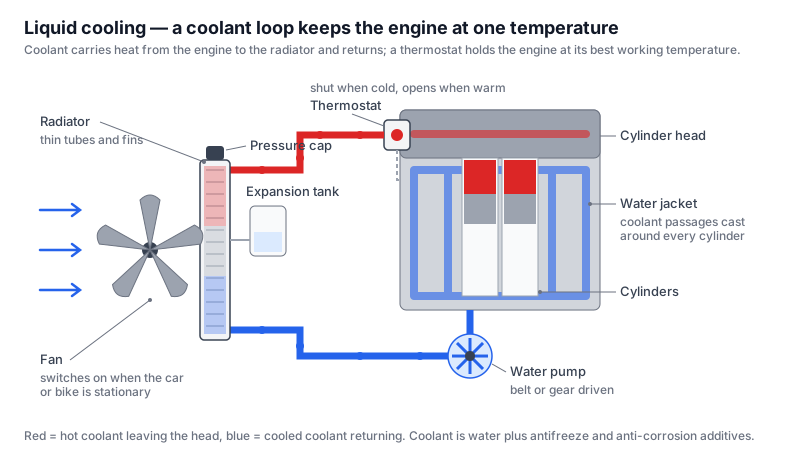
The coolant loop: pump, water jacket, thermostat, radiator with fan, and back. Red is hot coolant leaving the head, blue is cooled coolant returning. 
Radiator and hoses on a liquid-cooled V-twin motorcycle engine (Honda VTR250).Photo: Khaosaming · CC BY-SA 3.0 · Commons Learn Engineering's animation of an engine cooling system.Video: Learn Engineering
How it works
Every car and truck engine, and every performance or large-capacity two-wheeler, is liquid-cooled. Passages called water jackets are cast into the cylinder block and head. A belt- or gear-driven pump circulates coolant, water mixed with antifreeze and anti-corrosion additives, through these jackets, where it absorbs heat from the metal. The hot coolant leaves the top of the engine through a thermostat to the radiator, a block of thin tubes and fins at the front of the vehicle. Air flowing through the radiator, helped by a fan when the vehicle is slow or stopped, removes the heat, and the cooled liquid returns through the lower hose to the pump.
- The pump pushes coolant into the block and head.
- Coolant absorbs heat around each cylinder.
- The thermostat opens once the engine is warm; hot coolant goes to the radiator.
- Radiator and fan cool it, and it flows back to the pump.
The thermostat stays shut when the engine is cold so it warms up quickly, then opens to hold a steady temperature. A pressurised cap and an expansion tank let the coolant expand and keep it from boiling. Holding one temperature lets engineers set tight tolerances, run a leaner tune and extract more power from each cc, and it makes the engine quieter because the jacket damps mechanical noise. Riders of a KTM Duke, Yamaha R15, Bajaj Dominar, TVS Apache RR 310 or Royal Enfield Himalayan 450 get consistent performance in a Chennai traffic jam and on an expressway. The cost is weight, price and more parts: a pump, hoses, radiator, fan, thermostat and the coolant itself, which must be topped up and replaced on schedule. A leak or a stuck thermostat can overheat the engine quickly, so the temperature warning should never be ignored.
Pros
- Steady temperature in any traffic or climate
- Allows higher power from the same engine size
- Quieter running
Cons
- Heavier and costlier, with more parts
- Coolant needs topping up and periodic replacement
- A leak or failed thermostat can overheat the engine
Vehicles with this component
70 models on sale or coming. The note after the price is what the spec sheet says about this component; a variant name in brackets means only that trim brings it.
Motorcycles 67
- Bajaj Auto Dominar 250₹1.87 lakhLaunched 1 Mar 2020launched
 Bajaj Auto Dominar 400₹2.08 lakhPhoto: Cppfront · CC0 · Wikimedia CommonsLaunched 1 Apr 2019launched


