Petrol engine
EngineA spark-ignition engine that burns a petrol-air mixture inside cylinders to push pistons and turn a crankshaft.
Found on: Cars · Motorcycles · Scooters · Trucks
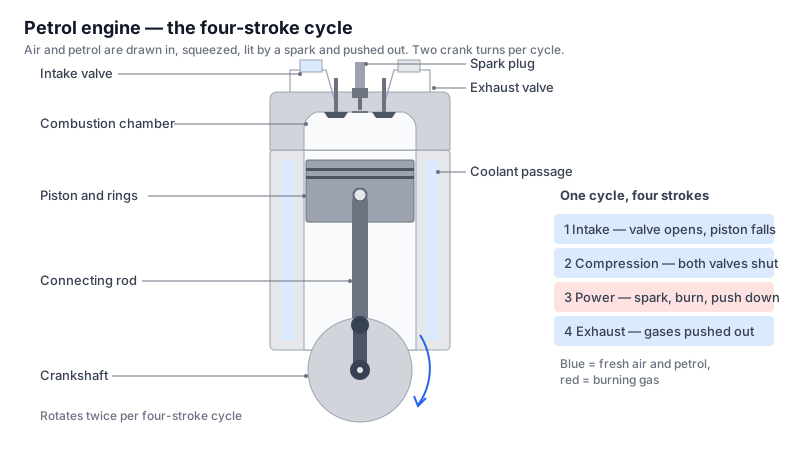
The four-stroke cycle in one cylinder: intake, compression, power, exhaust. The crank turns twice per cycle. 
Cutaway of a single-cylinder petrol motorcycle engine (Moto Guzzi Stornello 125): piston, valves, camshaft drive and crankshaft.Photo: CheminduCret · CC0 · Commons Toyota explains the basics of how a four-stroke petrol engine works.Video: Toyota USA
How it works
The petrol engine is the most common power unit in India, from a 100 cc commuter bike to a 1.5-litre SUV. It is an internal combustion engine: fuel burns inside closed cylinders and the expanding gas does the work. Almost every petrol vehicle sold today uses the four-stroke cycle, so each cylinder needs two full turns of the crankshaft to produce one power stroke.
- Intake: the piston moves down and draws in air through the open intake valve; petrol is injected into the port or directly into the cylinder.
- Compression: both valves close and the rising piston squeezes the mixture, which also heats it.
- Power: near the top, the spark plug fires, the mixture burns and the pressure drives the piston down. This is the only stroke that makes power.
- Exhaust: the exhaust valve opens and the piston pushes the burnt gas out towards the silencer.
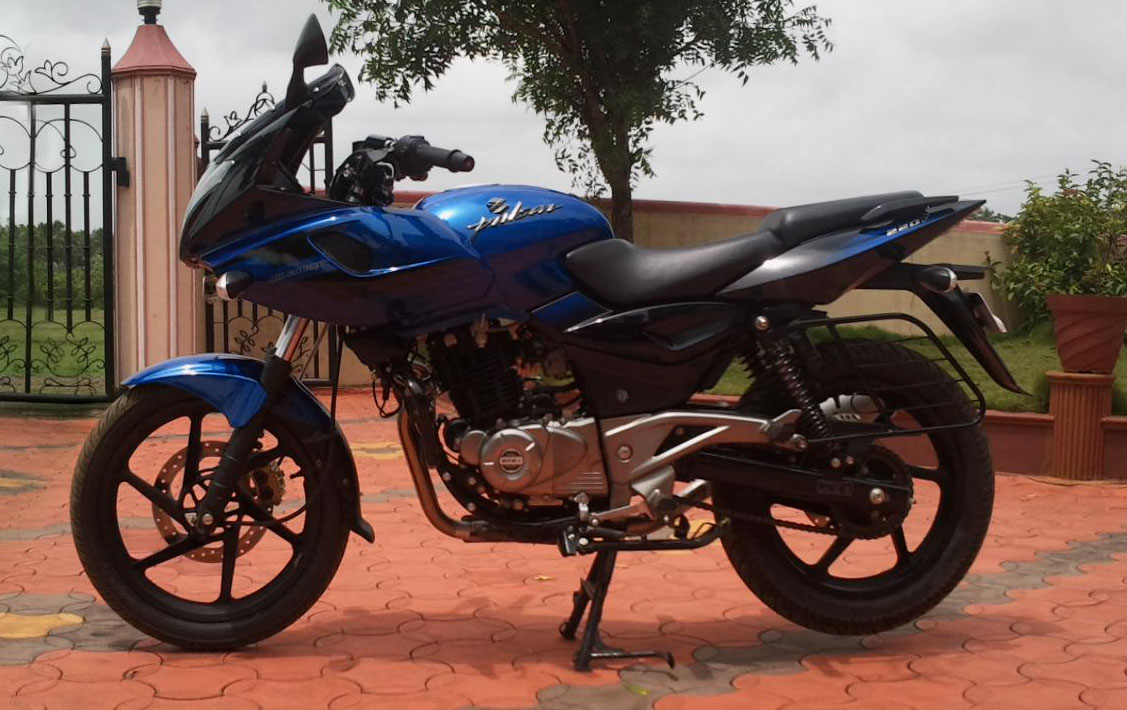
Connecting rods turn the up-and-down motion into rotation at the crankshaft, which feeds the clutch and gearbox. Camshafts open the valves at the right moment, and the engine control unit sets fuel quantity and spark timing many times a second. Bikes and scooters usually have one cylinder; small cars use three or four, which is why a Swift or an i20 feels smoother at idle than a Pulsar. Petrol engines rev freely, are light and quiet, and respond quickly to the throttle, but they are less efficient than diesels because the mixture cannot be compressed as hard without knocking. Most of them can also be adapted to run on CNG or paired with a hybrid system.
Pros
- Light, quiet and smooth
- Cheaper to buy and service than a diesel
- Responds quickly and revs freely
- Easily adapted to CNG or a hybrid system
Cons
- Lower fuel efficiency than a diesel
- Less pulling power at low revs
- Petrol costs more per litre than diesel or CNG in most Indian cities
Vehicles with this component
275 models on sale or coming. The note after the price is what the spec sheet says about this component; a variant name in brackets means only that trim brings it.
Cars 86
 BMW 2 Series Gran Coupe₹45.3 lakh – ₹47.2 lakh · 156 bhpPhoto: Alexander Migl · CC BY-SA 4.0 · Wikimedia CommonsLaunched 17 Jul 2025launched
 BMW 3 Series Gran Limousine₹60.45 lakh – ₹61.75 lakh · 258 bhpPhoto: LuvsMG481 · CC BY-SA 4.0 · Wikimedia Commons