Supercharger
EngineA compressor driven directly by the engine through a belt, giving instant boost from idle at the cost of some engine power.
Found on: Cars
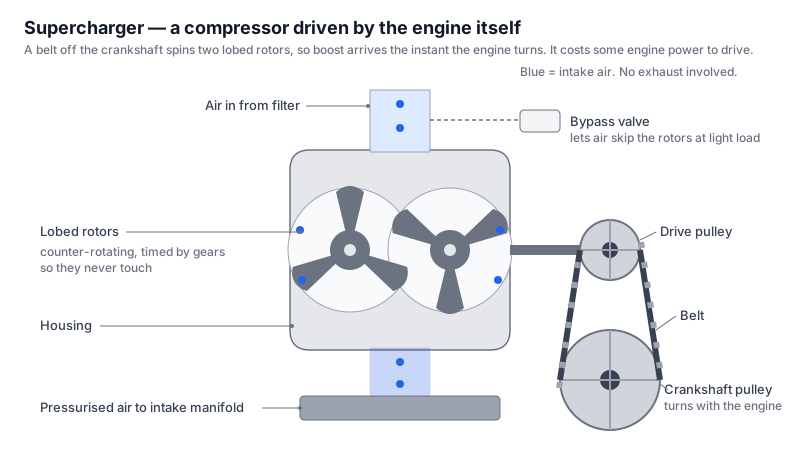
Roots-type supercharger: a belt from the crankshaft spins two lobed rotors that carry air from the inlet to the intake manifold. 
An Eaton MP62 Roots-type supercharger, the kind fitted on top of a V6 or V8 engine.Photo: Tennen-Gas · CC BY-SA 3.0 · Commons Engineering Explained: superchargers and how they differ from turbochargers.Video: Engineering Explained
How it works
A supercharger does the same job as a turbocharger, forcing extra air into the cylinders, but it is driven by the engine itself rather than by exhaust gas. A belt from the crankshaft pulley spins the compressor, so boost rises and falls exactly with engine speed. There is no waiting for a turbine to spool: press the pedal and the response is immediate, which is why superchargers were long favoured for a linear, big-engine feel.
The most common type on cars is the Roots or twin-screw blower, which sits on top of the engine. Two lobed rotors, geared together so they never touch, counter-rotate and carry pockets of air from the inlet at the top to the intake manifold below, where the air is compressed. A bypass valve lets air skip the rotors at light load so the unit does not waste power when boost is not needed. Centrifugal superchargers look like the cold side of a turbo but are belt-driven.
- Crankshaft pulley drives the supercharger belt.
- Rotors spin and push air into the manifold at above atmospheric pressure.
- An intercooler cools the compressed air before the cylinders.
- The bypass valve opens when the driver lifts off.
The cost is efficiency: driving the compressor takes a meaningful slice of the engine's output, so fuel use rises, and emissions rules have pushed makers towards turbos and electrification instead. In India superchargers appear almost only on imported performance cars; Jaguar Land Rover's older 3.0 V6 and 5.0 V8 petrols sold here were supercharged, and some Audi and Volvo engines once used them. No current mass-market Indian car is supercharged, so this entry mainly explains the term when it appears in a spec sheet.
Pros
- Instant response, no lag
- Boost available from idle
- Simpler plumbing than a turbo, no hot exhaust side
Cons
- Consumes engine power to run
- Poorer fuel economy
- Rare in India, so parts and expertise are scarce
Vehicles with this component
No model in the catalog is mapped to this component yet.