Strong hybrid system
EngineA petrol engine, two motor-generators and a small battery share the driving, so the engine shuts off and the car runs electrically in traffic.
Found on: Cars
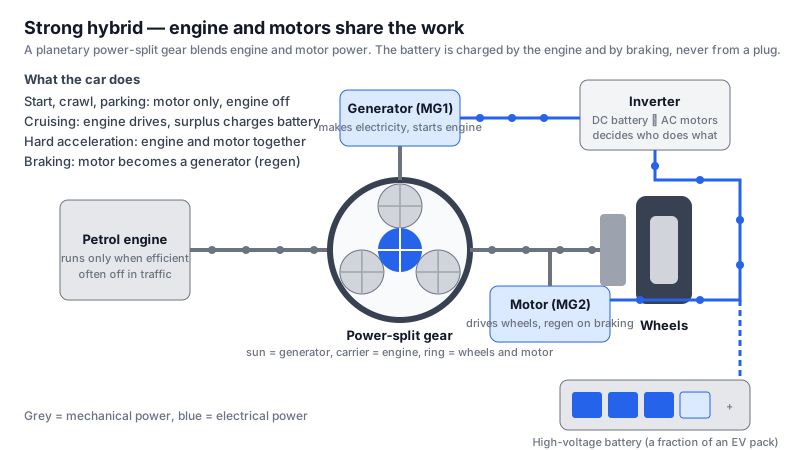
Power-split layout: engine and two motor-generators joined by a planetary gear; the inverter and battery handle the electrical side. 
Toyota Hybrid Synergy Drive display unit: petrol engine and hybrid transaxle with its two motor-generators.Photo: Karoly Lorentey from Budapest, Hungary · CC BY 2.0 · Commons Toyota India explains how its fourth-generation hybrid system works.Video: Toyota India
How it works
A strong (or self-charging) hybrid can move the car on electricity alone, which separates it from the mild hybrids that Maruti and Hyundai badge on many cars. The best-known layout is the series-parallel system used by Toyota and shared with Maruti: a petrol engine, two motor-generators and a small high-voltage battery, all joined by a planetary power-split gear instead of a conventional gearbox. The engine drives the carrier, one motor-generator sits on the sun gear and the wheels (with the second motor) on the ring gear. Varying the generator's speed changes the gear ratio continuously, which is why the spec sheet says e-CVT.
- Setting off and crawling: the engine stays off; the battery drives the traction motor.
- Cruising: the engine runs at an efficient speed, and part of its power turns the generator to top up the battery.
- Hard acceleration: engine and motor push together.
- Braking: the traction motor runs as a generator and slows the car, recovering energy that a normal car wastes as brake heat.
The battery is small, a fraction of an EV pack, and is never plugged in. The driver notices silent starts, an engine that switches on and off without fuss, and city mileage that is often better than highway mileage, the reverse of a normal car. In India the Toyota Innova Hycross, Urban Cruiser Hyryder, Maruti Grand Vitara and Honda City e:HEV use strong hybrids (Honda's e:HEV is a series type: the engine mostly generates and a motor drives). Cost is the catch: the hybrid parts add a lot to the price, and taxation treats them like petrol cars rather than EVs.
Pros
- Excellent city mileage, often better than on the highway
- Silent electric running in traffic
- Charges itself: no plug, no range anxiety
- Smooth, gearless drive
Cons
- Much higher price than the same car with a plain petrol engine
- Two power units to service, though hybrid batteries have proved long-lived
- Engine note rises with load rather than with road speed
- Battery can reduce boot or spare-wheel space
Vehicles with this component
14 models on sale or coming. The note after the price is what the spec sheet says about this component; a variant name in brackets means only that trim brings it.
Cars 14
 Honda Cars City(e:HEV ZX variant)₹12 lakh · 1,498 cc, 4-cylinder, 124.3 bhpPhoto: Dairokkan9 · CC BY-SA 4.0 · Wikimedia CommonsLaunched 2 Mar 2023launched
 Honda Cars ZR-V₹50 lakh · 4-cylinderPhoto: Calreyn88 · CC BY-SA 4.0 · Wikimedia Commons


