Lithium-ion battery
EngineThe EV's fuel tank: hundreds of lithium-ion cells grouped into a pack, with a management system that watches voltage and temperature.
Found on: Cars · Motorcycles · Scooters · Trucks
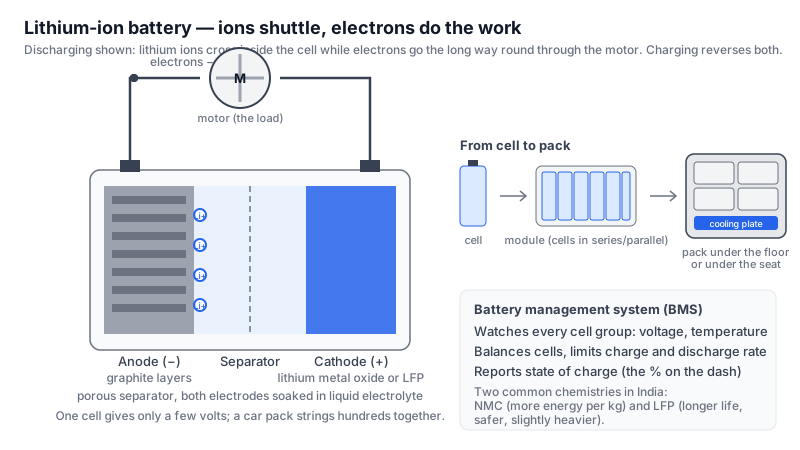
Discharging: lithium ions cross from anode to cathode inside the cell while electrons drive the motor outside. Cells build into modules and a pack with a BMS. 
A complete EV battery pack (Nissan Leaf) with its modules exposed, the flat shape that sits under the floor.Photo: Mariordo Mario Roberto Duran Ortiz · CC BY-SA 3.0 · Commons Engineering Explained: how a lithium-ion battery works.Video: Engineering Explained
How it works
A lithium-ion cell stores energy chemically. Inside are two electrodes, a graphite anode and a metal-oxide or lithium-iron-phosphate cathode, kept apart by a thin porous separator and soaked in a liquid electrolyte. When you drive, lithium ions migrate from the anode through the separator to the cathode, while the electrons they leave behind take the external route through the inverter and motor; that electron flow is the current. Charging pushes everything back the other way. A single cell gives only a few volts, so a scooter pack strings a few dozen in series and a car pack several hundred, often in parallel groups too.
- Cells are grouped into modules, with cooling plates or air channels between them.
- Modules are bolted into a sealed pack under the floor of a car or under the seat of a scooter.
- A battery management system (BMS) measures every cell group's voltage and temperature, balances them and limits charge and discharge current.
- The BMS computes the state of charge shown as a percentage on the dash.
Two chemistries dominate Indian EVs. NMC (nickel-manganese-cobalt) stores more energy per kilogram and suits long-range cars. LFP (lithium-iron-phosphate) is cheaper, tolerates heat and full charges better and lasts more cycles, which is why Tata and several newer models have moved to it, while performance scooters such as the Ather 450 stay on NMC. Capacity is quoted in kWh and is the single biggest factor in price and range; range also falls in extreme heat and with fast driving. Batteries fade slowly with age and cycles, so manufacturers give separate warranties on the pack, usually far longer than on the rest of the vehicle. Fast DC charging heats the pack, so the BMS slows the charge as it nears full to protect it.
Pros
- More range per kg than any other rechargeable chemistry
- No tailpipe emissions and very cheap per km on home charging
- Long pack warranties are now standard
Cons
- The most expensive single part of an EV
- Range drops in extreme heat and with fast driving
- Charging takes far longer than a fuel fill
- Capacity fades slowly over the years
Vehicles with this component
85 models on sale or coming. The note after the price is what the spec sheet says about this component; a variant name in brackets means only that trim brings it.
Cars 33
 BYD Atto 3₹24.99 lakh – ₹34.49 lakh · 49.92 kWh, 468 km claimed rangePhoto: LuvsMG481 · CC BY-SA 4.0 · Wikimedia CommonsLaunched 11 Oct 2022launched
 BYD eMax 7₹27.9 lakh – ₹29.9 lakh · 71.8 kWh, 485 km claimed rangePhoto: Ethan Llamas · CC BY-SA 4.0 · Wikimedia Commons


