Electric traction motor
EngineThe motor that drives an EV's wheels: a rotating magnetic field in the stator drags the rotor round, with full torque from standstill.
Found on: Cars · Motorcycles · Scooters · Trucks
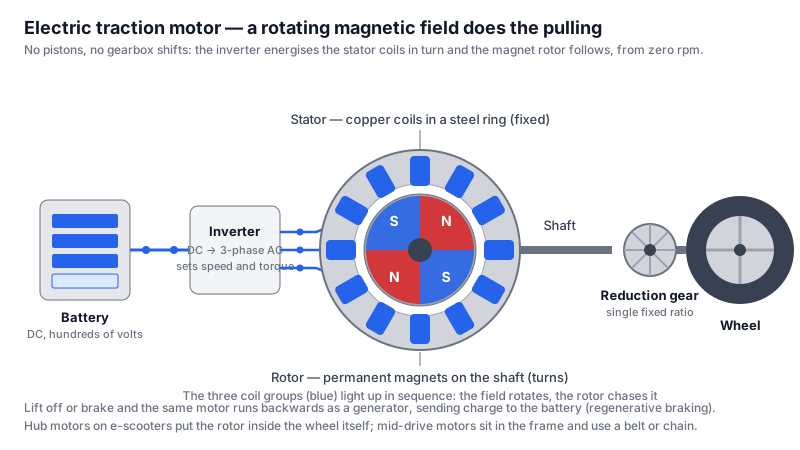
Battery DC becomes three-phase AC in the inverter; the stator coils fire in sequence and the magnet rotor follows, driving the wheel through a reduction gear. 
The traction motor and reduction gear unit of a Nissan Leaf on display.Photo: Mariordo Mario Roberto Duran Ortiz · CC BY-SA 3.0 · Commons Engineering Explained: how the AC motors in electric cars work.Video: Engineering Explained
How it works
An electric vehicle replaces the engine, clutch and gearbox with a traction motor and a single-speed reduction gear. The motor has two parts. The stator is a fixed ring of steel with copper coils wound into it. The rotor turns inside it on the output shaft and carries either permanent magnets (the permanent-magnet synchronous motor used by most Indian EVs, from the Nexon EV to the Ather 450) or a cage of conductors (an induction motor, used in some older EVs and many electric buses).
Battery packs deliver direct current, but the motor needs alternating current, so an inverter sits between them. It switches the DC into three-phase AC and varies both frequency and current.
- The inverter energises the three coil groups in sequence.
- Their combined magnetic field rotates around the stator.
- The rotor's magnets (or induced currents) are dragged along with the field.
- Faster switching means faster rotation; more current means more torque.
Because torque is available from zero rpm, an EV pulls away instantly and smoothly with no gear changes, which is the first thing a Nexon EV or Ola S1 rider notices. Lift off the accelerator and the inverter runs the motor as a generator: it slows the vehicle and feeds charge to the battery (regenerative braking). The whole unit is small, quiet and has a single moving part, so servicing is minimal. Scooters often use a hub motor built into the rear wheel (Bajaj Chetak, Ola S1) or a mid-drive motor in the frame with a belt (Ather). Heat is the limit: motors and inverters are usually liquid-cooled on cars and will reduce power if pushed hard for long on a hot day.
Pros
- Instant, silent torque with no gear changes
- Very few moving parts, little servicing
- Recovers energy when slowing (regen)
- Compact enough to fit inside a wheel hub
Cons
- Needs a heavy battery to feed it
- Can cut power when overheated on long hard runs
- Rare-earth magnets in most designs are costly
Vehicles with this component
83 models on sale or coming. The note after the price is what the spec sheet says about this component; a variant name in brackets means only that trim brings it.
Cars 31
 BYD Atto 3₹24.99 lakh – ₹34.49 lakh · 201.2 bhpPhoto: LuvsMG481 · CC BY-SA 4.0 · Wikimedia CommonsLaunched 11 Oct 2022launched
 BYD eMax 7₹27.9 lakh – ₹29.9 lakh · 160.9 bhpPhoto: Ethan Llamas · CC BY-SA 4.0 · Wikimedia Commons


