Upside-down (USD) fork
SuspensionA telescopic fork turned over so the fat tube is clamped at the top: stiffer under braking and lighter at the wheel.
Found on: Motorcycles · Scooters
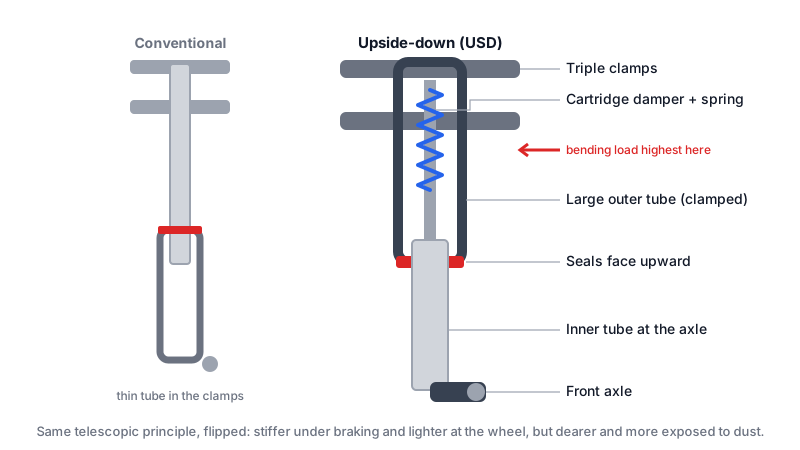
Conventional fork (left) beside a USD fork: the large tube is clamped at the top and the slim tube carries the axle. 
USD fork on a Ducati 916 SPS: the gold outer tube is above, the polished inner tube runs down to the axle and brake caliper.Photo: ScuderiaAssindia · CC BY-SA 3.0 · Commons Why inverted forks are stiffer and where they fall short.Video: Motorcyclist Magazine
How it works
An upside-down fork, also called an inverted or USD fork, works exactly like a conventional telescopic fork but with the tubes the other way round. The large-diameter outer tube is clamped in the triple clamps, and the slimmer inner tube points down to the front axle. Most USD forks also carry a cartridge damper, a sealed piston-and-valve unit, instead of a simple damper rod. Once reserved for superbikes, it now appears on mass-market Indian motorcycles such as the KTM 390 Duke, Yamaha R15, Bajaj Pulsar NS200, TVS Apache RTR 200 4V and the Royal Enfield Himalayan 450.
- The front wheel rises and the inner tube slides up into the outer tube, compressing the spring.
- The cartridge piston pushes oil through shim stacks that open progressively with speed, giving finer control of compression than drilled holes.
- Under hard braking the fork bends backward; the stiffest part of the assembly, the big outer tube, is where that bending load is greatest, so the fork flexes less and the wheel stays pointed where the rider aims it.
- On rebound a second valve set controls the return.
The rider notices sharper, more consistent steering under braking and a more controlled feel over sharp bumps, partly because the lighter inner tube and axle clamp reduce the weight that has to move with the wheel. The downsides are cost and exposure: the seals face upward, so dust and water sit on them, and a scratch on the inner tube, which is now at the bottom where stones hit, can tear a seal. Many riders fit fork guards or neoprene gaiters for Indian roads.
Pros
- Much stiffer under braking and cornering loads
- Less unsprung weight at the wheel, so the tyre tracks better
- Usually paired with cartridge damping that can be adjusted
Cons
- Costlier to make and to repair
- Seals face up towards dust and water and wear faster
- Exposed lower tubes are vulnerable to stone chips
Vehicles with this component
49 models on sale or coming. The note after the price is what the spec sheet says about this component; a variant name in brackets means only that trim brings it.
Motorcycles 49
- Bajaj Auto Dominar 250₹1.87 lakh · frontLaunched 1 Mar 2020launched
 Bajaj Auto Dominar 400₹2.08 lakh · frontPhoto: Cppfront · CC0 · Wikimedia CommonsLaunched 1 Apr 2019launched
Related: other suspension components
- MacPherson strut
- Double wishbone
- Multi-link suspension
- Torsion bar suspension
- Torsion beam axle
- Leaf spring suspension
- Parabolic leaf spring
- Air suspension
- Rigid axle (live axle)
- Independent front suspension (trucks)
- Bogie (tandem axle) suspension
- Telescopic fork
- Leading-link fork
- Trailing-link fork
- Monoshock
- Twin shock absorbers
- Unit-swing suspension


