Torsion bar suspension
SuspensionA long steel bar twisted by the control arm acts as the spring, saving the space a coil spring would need.
Found on: Cars
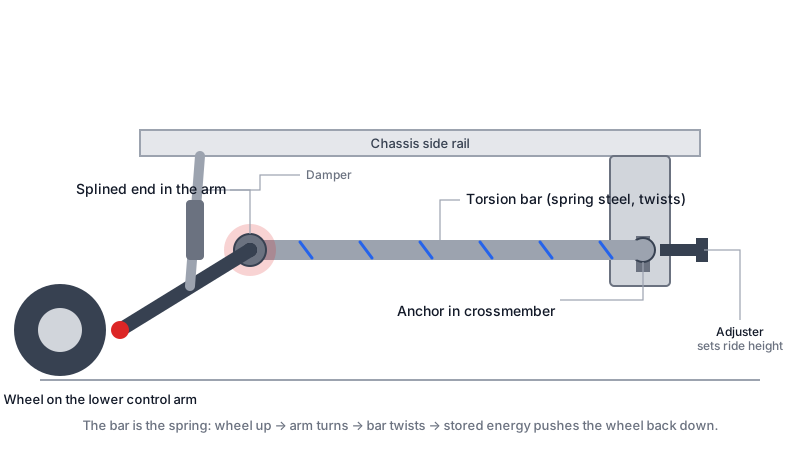
Side view: the control arm turns the splined end of the bar, which twists along the chassis to its anchor and adjuster. 
Workshop drawing of an Alfa Romeo Alfetta front suspension with the two longitudinal torsion bars highlighted in red.Photo: The RedBurn · CC BY-SA 4.0 · Commons Torsion bar suspension basics from a suspension manufacturer.Video: Superlift Suspension
How it works
In a torsion bar suspension the spring is not a coil but a straight bar of spring steel, usually running lengthwise along the chassis rail. One end is splined into the lower control arm so the two turn together; the other end is anchored to a crossmember through an adjustable lever. When the wheel moves, the arm rotates the bar and the bar twists, storing energy exactly as a coil spring does when squeezed. Indian buyers met it on the Tata Sumo and the original Safari, the Toyota Qualis and the Chevrolet Tavera, all of which paired torsion bars with an independent double wishbone front end; it survives on a few pickups and light trucks.
- The wheel hits a bump and the lower control arm swings up around the torsion bar axis.
- The splined joint forces the bar to twist along its whole length.
- The twisted bar pushes back, returning the wheel to the road; a conventional damper mounted beside it controls the speed.
- Turning the adjuster bolt at the anchor end pre-twists the bar, which raises or lowers that corner of the vehicle.
Because there is no coil spring, the suspension is low and compact, which suits a vehicle with a big engine or long-travel wheels, and ride height can be reset with a spanner rather than new springs. The driver notices a slightly firm, rugged feel. Bars can sag with age or heavy use, and mechanics must relieve the stored twist before dismantling anything, so a worn setup should only be adjusted by someone who knows the layout.
Pros
- Compact: no coil spring needed around the damper
- Ride height is adjustable with a bolt
- Simple, robust and well suited to heavy loads
Cons
- Spring rate is fixed by the bar, so it cannot easily be made progressive
- Bars can sag or break after long hard use
- Stored twist makes servicing hazardous for the untrained
Vehicles with this component
No model in the catalog is mapped to this component yet.
Related: other suspension components
- MacPherson strut
- Double wishbone
- Multi-link suspension
- Torsion beam axle
- Leaf spring suspension
- Parabolic leaf spring
- Air suspension
- Rigid axle (live axle)
- Independent front suspension (trucks)
- Bogie (tandem axle) suspension
- Telescopic fork
- Upside-down (USD) fork
- Leading-link fork
- Trailing-link fork
- Monoshock
- Twin shock absorbers
- Unit-swing suspension