Leaf spring suspension
SuspensionA stack of curved steel strips clamped to the axle springs the vehicle and locates the axle, with no extra links.
Found on: Cars · Trucks
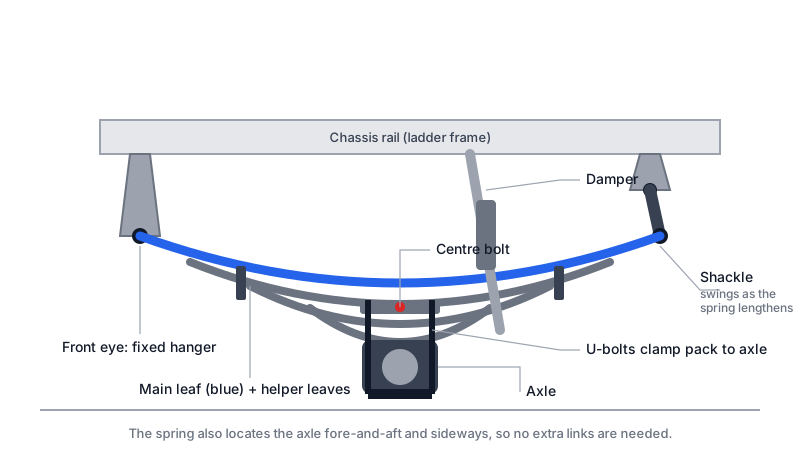
Side view: the leaf pack flattens under load, the rear shackle swings to let it lengthen, and U-bolts clamp it to the axle. 
Leaf-sprung tri-axle semi-trailer: the spring packs, their hangers and the axles are all visible between the twin tyres.Photo: Bertux · CC BY-SA 4.0 · Commons How leaf spring suspension works, 3D animation.Video: Creative Surface
How it works
The leaf spring is the oldest vehicle suspension still in production and the standard rear suspension of Indian trucks, pickups and vans such as the Tata Ace, Mahindra Bolero, Ashok Leyland Dost and Isuzu D-Max. A spring is a stack of curved spring-steel strips, the longest main leaf on top with shorter helper leaves below, held together by a centre bolt and rebound clips. The pack is clamped to the axle by two U-bolts. Its front eye is pinned to a fixed hanger on the chassis rail; its rear eye hangs from a shackle, a short swinging link.
- Load or a bump pushes the axle up towards the chassis and the arched pack flattens.
- As it flattens the spring gets longer, so the shackle swings backward to let the rear eye move.
- The leaves slide over one another and the friction between them absorbs some of the energy; a separate damper does the rest.
- The pack springs back to its arch and the shackle swings forward again.
- The stiff pack also stops the axle moving sideways or twisting under drive and braking forces.
Because the spring both carries the load and locates the axle, no control arms, bushes or anti-roll bar are needed, which keeps a commercial vehicle cheap and easy to repair with simple tools anywhere in the country. The driver notices a stiff, bouncy ride when the vehicle is empty, settling into a comfortable one when fully loaded, and the occasional creak from dry leaves. Overloading permanently flattens the arch, so a sagging rear end is a common sight on hard-worked trucks.
Pros
- Carries very heavy loads for its cost
- Locates the axle by itself, so there are no links or bushes to replace
- Easy to repair or re-arch at any roadside workshop
Cons
- Harsh and bouncy when the vehicle is unladen
- Inter-leaf friction makes the ride sticky and the springs squeak
- Heavy, and the axle can wind up under hard acceleration or braking
Vehicles with this component
34 models on sale or coming. The note after the price is what the spec sheet says about this component; a variant name in brackets means only that trim brings it.
Cars 2
 Isuzu Motors India V-CrossPrice TBA · rearPhoto: Bcarkhabri · CC BY-SA 4.0 · Wikimedia CommonsLaunched 1 Feb 2021launched
 Mahindra Bolero₹8.57 lakh – ₹9.99 lakh · rearPhoto: Oleg Yunakov · CC BY-SA 4.0 · Wikimedia Commons
Related: other suspension components
- MacPherson strut
- Double wishbone
- Multi-link suspension
- Torsion bar suspension
- Torsion beam axle
- Parabolic leaf spring
- Air suspension
- Rigid axle (live axle)
- Independent front suspension (trucks)
- Bogie (tandem axle) suspension
- Telescopic fork
- Upside-down (USD) fork
- Leading-link fork
- Trailing-link fork
- Monoshock
- Twin shock absorbers
- Unit-swing suspension


