Double wishbone
SuspensionTwo A-shaped arms, one above the other, hold the wheel so its angle to the road can be tuned precisely.
Found on: Cars
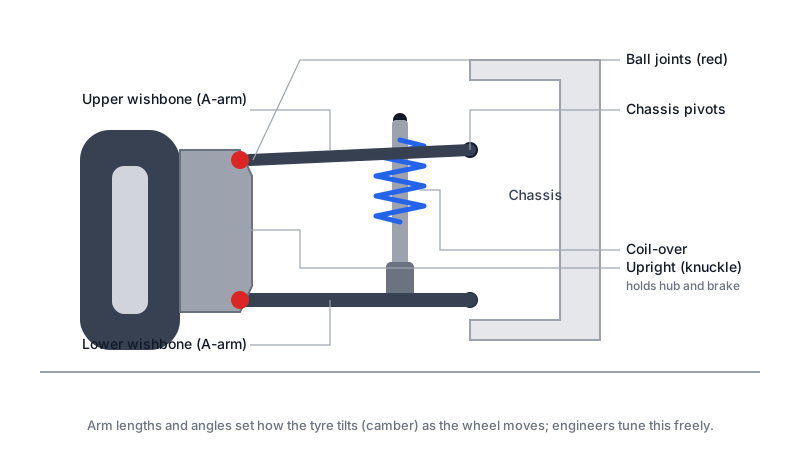
Front view: upper and lower wishbones swing on the chassis as the wheel rises; the coil-over sits on the lower arm. 
Cutaway display of a double wishbone front suspension: both wishbones and the upright painted yellow, coil-over in red and blue, sectioned hub and brake.Photo: RB30DE · CC BY-SA 3.0 · Commons Double wishbone suspension explained.Video: Engineering Explained
How it works
A double wishbone (also called a double A-arm) suspension holds the wheel upright between two triangular arms. Each wishbone pivots on the chassis at its wide end and connects to the upright, or knuckle, through a ball joint at its narrow end. The coil spring and damper usually sit on the lower arm as a coil-over unit and are separate from the job of locating the wheel. You will find it at the front of body-on-frame SUVs and pickups such as the Toyota Fortuner, Mahindra Scorpio-N and Mahindra Thar, and in some premium sedans.
- Over a bump the wheel rises and both arms swing upward about their chassis pivots.
- Because the upper arm is shorter than the lower one, the top of the wheel tilts inward slightly as it rises. Engineers choose the arm lengths so the tyre stays flat on the road while the body leans in a corner.
- The coil-over compresses; the damper turns the movement into heat so the body does not keep bouncing.
- Steering turns the upright on its two ball joints while the arms stay put.
The arms take all the cornering, braking and bump loads, so the spring and damper only have to do their own jobs; this is why the layout is used in racing. The driver feels planted, consistent cornering and good steering feedback, and off-road the design copes well with long wheel travel. The price is more parts, more ball joints and bushes to wear, and more space taken up on either side of the engine.
Pros
- Tyre stays upright in corners, so grip and steering feel are excellent
- Spring and damper rates can be chosen independently of wheel location
- Handles long wheel travel, useful off-road
Cons
- More parts, ball joints and bushes than a strut, so costlier to make and maintain
- Takes up width in the engine bay
- Alignment is sensitive to worn bushes
Vehicles with this component
7 models on sale or coming. The note after the price is what the spec sheet says about this component; a variant name in brackets means only that trim brings it.
Cars 7
 Isuzu Motors India mu-XPrice TBA · frontPhoto: Vogue2Voke · CC BY-SA 4.0 · Wikimedia CommonsLaunched 1 Aug 2021launched
 Isuzu Motors India V-CrossPrice TBA · frontPhoto: Bcarkhabri · CC BY-SA 4.0 · Wikimedia CommonsLaunched 1 Feb 2021launched
Related: other suspension components
- MacPherson strut
- Multi-link suspension
- Torsion bar suspension
- Torsion beam axle
- Leaf spring suspension
- Parabolic leaf spring
- Air suspension
- Rigid axle (live axle)
- Independent front suspension (trucks)
- Bogie (tandem axle) suspension
- Telescopic fork
- Upside-down (USD) fork
- Leading-link fork
- Trailing-link fork
- Monoshock
- Twin shock absorbers
- Unit-swing suspension


