Air suspension
SuspensionRubber bellows filled with compressed air replace steel springs and keep ride height constant whatever the load.
Found on: Cars · Trucks
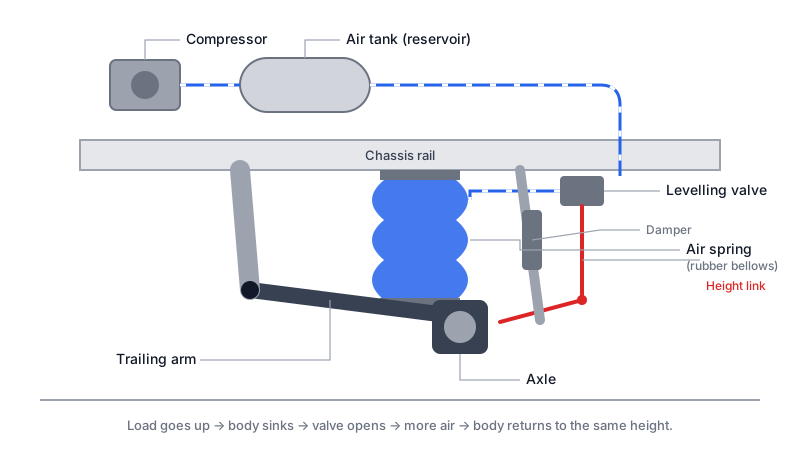
Truck axle, side view: compressor, tank and levelling valve feed the rubber bellows between chassis rail and trailing arm. 
Truck beam axle sprung by a rubber air bellows under the chassis rail, with the damper and levelling linkage alongside.Photo: Tennen-Gas · CC BY-SA 3.0 · Commons What an air suspension is and how it works.Video: Engineering Explained
How it works
Air suspension replaces the steel spring with an air spring: a tough rubber bellows, shaped like a bag or a rolling lobe, that sits between the chassis and the axle. An engine-driven compressor fills a reservoir tank, and a levelling valve on the chassis, worked by a link to the axle, lets air in or out of each bellows. In India it is standard on Volvo and Scania luxury coaches, offered on some premium haulage tractors and tankers, and found under luxury cars from Mercedes-Benz and others, where the driver can also choose ride height and firmness from a button.
- More load is placed on the vehicle and the body sinks towards the axle.
- The levelling link tilts the valve, which opens and feeds more air from the tank into the bellows.
- The higher pressure lifts the body until the link returns the valve to neutral: ride height is back to normal.
- Remove the load and the valve vents air to bring the body down again.
- A conventional damper beside each bellows controls the bouncing.
Compressed air springs are naturally progressive, soft over small bumps and stiffer as they compress, which gives the gliding ride passengers notice on a Volvo bus and keeps a loaded truck level so the headlamps and brakes work as designed. For transporters the ability to lower the chassis to meet a loading dock, or to raise a lift axle, is a bonus. The drawbacks are cost and complexity: bellows perish, air lines leak, compressors fail, and a flat air spring leaves the vehicle sitting on its bump stops until it is repaired.
Pros
- Ride height stays constant from empty to fully loaded
- Soft, progressive ride that protects passengers and fragile cargo
- Height can be adjusted for loading docks or lift axles
Cons
- Expensive and complex: compressor, tank, valves and lines
- Bellows and lines can leak, leaving the vehicle on its bump stops
- Needs a dry, clean air supply and periodic servicing
Vehicles with this component
1 model on sale or coming. The note after the price is what the spec sheet says about this component; a variant name in brackets means only that trim brings it.
Trucks & Commercial 1
 Volvo Trucks FM ElectricPrice TBA · front and rearPhoto: MarcelX42 · CC BY-SA 4.0 · Wikimedia CommonsExpected TBAupcoming
Related: other suspension components
- MacPherson strut
- Double wishbone
- Multi-link suspension
- Torsion bar suspension
- Torsion beam axle
- Leaf spring suspension
- Parabolic leaf spring
- Rigid axle (live axle)
- Independent front suspension (trucks)
- Bogie (tandem axle) suspension
- Telescopic fork
- Upside-down (USD) fork
- Leading-link fork
- Trailing-link fork
- Monoshock
- Twin shock absorbers
- Unit-swing suspension