MacPherson strut
SuspensionA single strut combining the coil spring and damper doubles as the upper locating member of the front wheel.
Found on: Cars
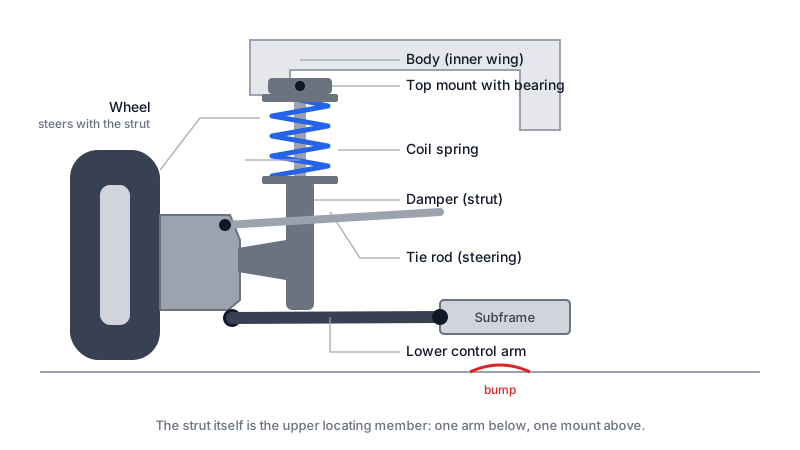
Front view of one wheel: the strut carries the spring and damper from the knuckle to the body; one lower arm locates the bottom. 
3D model of a MacPherson strut corner: strut and coil spring (top), knuckle, lower arm and tie rod.Photo: User Casito on en.wikipedia · CC BY-SA 3.0 · Commons MacPherson strut suspension explained with a model.Video: Engineering Explained
How it works
The MacPherson strut is the front suspension on almost every hatchback, sedan and compact SUV sold in India, from the Maruti Swift and Hyundai Creta to the Tata Nexon. It packs the coil spring and the hydraulic damper into one upright unit, the strut, which bolts to the steering knuckle at the bottom and to the car body at the top through a rubber mount with a bearing. A single lower control arm (wishbone) locates the bottom of the knuckle to the subframe, and a tie rod from the steering rack turns the whole assembly.
- The tyre meets a bump and the wheel and knuckle move upward.
- The strut, which is fixed to the knuckle, telescopes: the damper rod pushes into the damper tube and the coil spring compresses.
- Oil inside the damper is forced through small valves, converting the bounce energy into heat so the car settles instead of bouncing.
- The lower arm swings on its bushes to guide the wheel up and down; the top mount bearing lets the strut rotate when you steer.
- The spring pushes the wheel back onto the road while the damper controls the speed of the return.
Because the strut replaces an upper arm, there is nothing above the wheel but the strut tower, which frees space in the engine bay of a front-wheel-drive car. The driver notices a soft, forgiving ride and light steering; on hard cornering a strut car tilts its outside tyre a little, which is why performance cars prefer double wishbones. Worn struts show up as a floaty ride, knocking from the top mounts, or uneven tyre wear.
Pros
- Compact and light, leaving room for a transverse engine and driveshafts
- Cheap to build and simple to service as one unit
- Low friction and good ride comfort on rough roads
Cons
- Tyre camber changes as the body rolls, so cornering grip is limited
- Bonnet line must be tall enough to house the strut tower
- Top mounts and strut bearings wear and start to knock on bad roads
Vehicles with this component
27 models on sale or coming. The note after the price is what the spec sheet says about this component; a variant name in brackets means only that trim brings it.
Cars 27
 Honda Cars Amaze₹7.65 lakh · frontPhoto: Ashwin's Garage · CC BY 3.0 · Wikimedia CommonsLaunched 1 Dec 2024launched
 Honda Cars Amaze 2nd Gen₹6.98 lakh · frontPhoto: Sherwin · CC BY-SA 4.0 · Wikimedia Commons
Related: other suspension components
- Double wishbone
- Multi-link suspension
- Torsion bar suspension
- Torsion beam axle
- Leaf spring suspension
- Parabolic leaf spring
- Air suspension
- Rigid axle (live axle)
- Independent front suspension (trucks)
- Bogie (tandem axle) suspension
- Telescopic fork
- Upside-down (USD) fork
- Leading-link fork
- Trailing-link fork
- Monoshock
- Twin shock absorbers
- Unit-swing suspension


