Monoshock
SuspensionOne central spring and damper unit between the swingarm and frame, often through a linkage, controls the rear wheel.
Found on: Motorcycles · Scooters
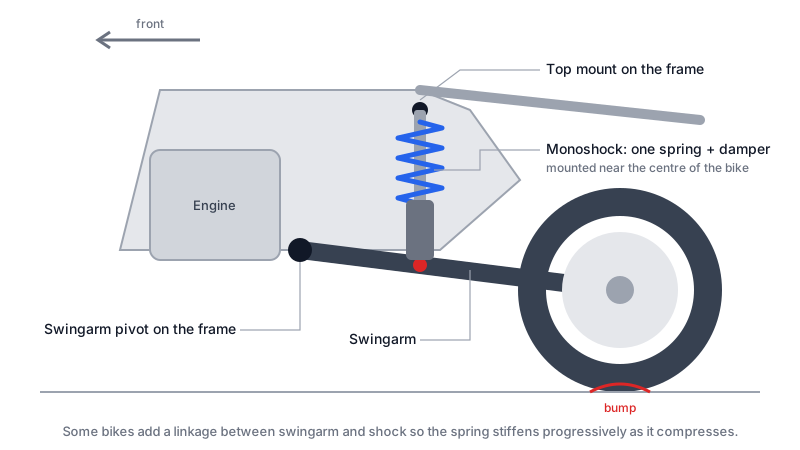
Side view: the swingarm swings up over a bump and compresses the single shock mounted near the centre of the bike. 
Monoshock on a Ducati Panigale: the single coil-over unit with its remote reservoir sits between the swingarm and the frame.Photo: andy carter from England · CC BY 2.0 · Commons Monoshock versus twin-shock: which is better and why.Video: Revving Heart
How it works
A monoshock replaces the pair of rear shock absorbers with a single, larger unit mounted close to the centre of the bike. The rear wheel is carried on a swingarm that pivots on the frame just behind the engine. The shock connects the swingarm, either directly or through a linkage of rocker and rods, to a mount high on the frame under the seat. Almost every sporty Indian motorcycle uses one, from the Bajaj Pulsar NS200 and TVS Apache RTR 160 4V to the KTM Duke range and the Royal Enfield Himalayan, as do electric scooters such as the Ather 450X.
- The rear tyre hits a bump and the swingarm swings up about its pivot.
- The swingarm pushes the shock, compressing the coil spring and forcing oil through the damper valves.
- With a linkage, the rocker changes the leverage as the wheel rises, so the spring effectively gets stiffer the further it is compressed: a rising rate.
- The spring returns the wheel while the damper controls the speed of return.
A rising rate is the monoshock's great advantage: soft over small ripples, firm enough not to bottom out over a big pothole or with a pillion. Mounting one unit near the centre of gravity also frees space at the back for a slim tail and lets the shock be bigger and better cooled. The rider notices a planted rear in corners and fewer bottoming thumps on bad roads. Linkage bearings need periodic greasing, and a single shock has to be built well, since there is no second unit to share the work.
Pros
- Linkage gives a progressive rate: soft at first, firm when loaded
- One large unit is better controlled and cooled than two small ones
- Frees up space for a slimmer tail and tidier chassis
Cons
- Linkage bearings and pivots need periodic servicing
- Harder to adjust or replace than twin shocks
- Costlier than a pair of simple shocks
Vehicles with this component
83 models on sale or coming. The note after the price is what the spec sheet says about this component; a variant name in brackets means only that trim brings it.
Motorcycles 77
- Bajaj Auto Dominar 250₹1.87 lakh · rearLaunched 1 Mar 2020launched
 Bajaj Auto Dominar 400₹2.08 lakh · rearPhoto: Cppfront · CC0 · Wikimedia CommonsLaunched 1 Apr 2019launched
Related: other suspension components
- MacPherson strut
- Double wishbone
- Multi-link suspension
- Torsion bar suspension
- Torsion beam axle
- Leaf spring suspension
- Parabolic leaf spring
- Air suspension
- Rigid axle (live axle)
- Independent front suspension (trucks)
- Bogie (tandem axle) suspension
- Telescopic fork
- Upside-down (USD) fork
- Leading-link fork
- Trailing-link fork
- Twin shock absorbers
- Unit-swing suspension


