Multi-link suspension
SuspensionFour or five separate links each control one direction of wheel movement, giving the best ride and handling compromise.
Found on: Cars
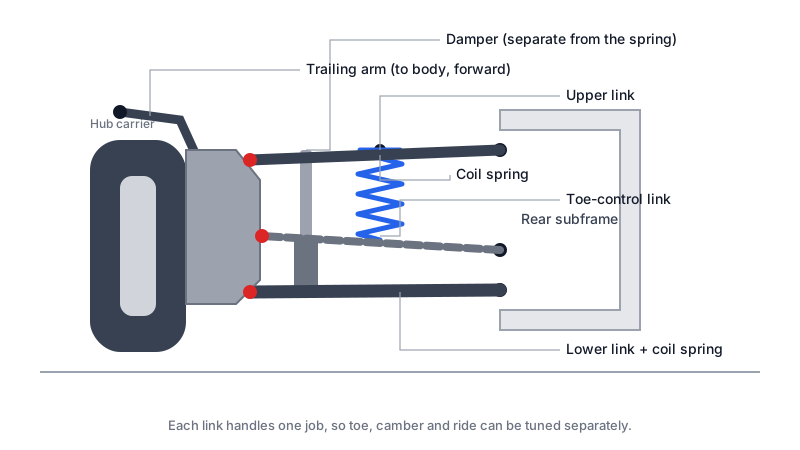
Rear view of one wheel: upper link, toe-control link, lower link with the coil spring, and a trailing arm reaching forward to the body. 
Complete multi-link rear subframe of a Toyota Supra on display: several separate links on each side locate the hub carriers.Photo: TTTNIS · CC0 · Commons How multi-link suspension works, shown on a real car.Video: speedkar99
How it works
Multi-link suspension is the double wishbone taken a step further: instead of two rigid triangles, the wheel hub is located by four or five individual rods, or links, each with a bush or ball joint at both ends. A typical rear layout has an upper link, a lower link that also carries the coil spring, a toe-control link and a trailing arm reaching forward to the body, with the damper mounted separately. In India it is found at the rear of larger SUVs such as the Mahindra XUV700, Hyundai Tucson and Skoda Kodiaq, and on most German luxury cars at both ends.
- A bump pushes the hub carrier upward; every link pivots about its inner bush.
- The lengths and angles of the links decide how the wheel moves: the toe link keeps the wheel pointing straight, the lateral links control camber, and the trailing arm absorbs fore-and-aft shock.
- Because each link has only one job, engineers can let the wheel move backward a little when it hits a sharp edge (good for comfort) while still keeping it stiff sideways (good for cornering).
- The spring and damper handle the bounce as in any other suspension.
The driver notices that the car rides softly over broken tarmac yet stays composed in fast corners, and that the rear stays planted under braking. Over the years the many rubber bushes wear, which brings vague handling and clunks; replacing them is fiddly and the wheel alignment has more settings than on a simpler car. The system is also heavier and needs more space, which is why small cars stick to a torsion beam.
Pros
- Best balance of ride comfort and cornering stability
- Toe, camber and compliance can each be tuned on their own
- Rear wheels can be driven or steered without compromise
Cons
- Expensive to build, with many bushes and joints that wear
- Heavier and bulkier than a torsion beam
- Alignment is complex and sensitive to damage
Vehicles with this component
10 models on sale or coming. The note after the price is what the spec sheet says about this component; a variant name in brackets means only that trim brings it.
Cars 10
 Force Motors Gurkha₹16.52 lakh – ₹17.83 lakh · front and rearPhoto: Vish The Weekender · CC BY 3.0 · Wikimedia CommonsLaunched 1 May 2024launched
 Honda Cars ZR-V₹50 lakh · rearPhoto: Calreyn88 · CC BY-SA 4.0 · Wikimedia CommonsLaunched 1 Jul 2026launched
Related: other suspension components
- MacPherson strut
- Double wishbone
- Torsion bar suspension
- Torsion beam axle
- Leaf spring suspension
- Parabolic leaf spring
- Air suspension
- Rigid axle (live axle)
- Independent front suspension (trucks)
- Bogie (tandem axle) suspension
- Telescopic fork
- Upside-down (USD) fork
- Leading-link fork
- Trailing-link fork
- Monoshock
- Twin shock absorbers
- Unit-swing suspension


