Leading-link fork
SuspensionA rigid fork with a short link ahead of its pivot carrying the axle, which resists nose-dive under braking.
Found on: Scooters · Motorcycles
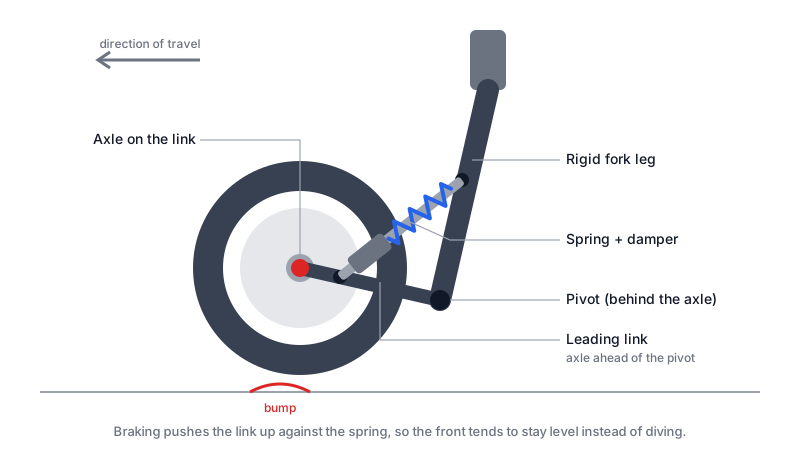
Side view: the link swings up about a pivot behind the axle, compressing the spring and damper against the rigid fork leg. 
BMW R27 with an Earles-type leading-link fork: the long link pivots behind the wheel and carries the axle ahead of it, sprung by exposed shocks.Photo: Badseed · CC BY-SA 3.0 · Commons
How it works
A leading-link fork does away with sliding tubes. A rigid fork comes down from the steering head, and near its bottom a short link is pivoted; the link runs forward to the wheel axle, so the wheel leads the pivot. A spring and damper unit mounted between the link and the fork leg carries the load. The layout was common on motorcycles in the 1950s and 60s, notably the Earles fork on BMW twins, and survives on sidecar outfits such as the Ural, on some small-wheeled mopeds and step-throughs, and, closer to home, on the electric Bajaj Chetak, whose spec sheet lists a single-sided leading link at the front.
- The front wheel rises over a bump and the link swings upward around its pivot.
- The spring between the link and the rigid fork compresses, and the damper slows the motion.
- Because the link is short, the wheel moves in a slight arc rather than straight up; the geometry is chosen so this arc helps rather than upsets the steering.
- Under braking the brake torque tries to rotate the wheel and link forward and up, which pushes against the spring and counteracts the dive that a telescopic fork would show.
The rider notices that the front stays level under hard braking, a plush response to small bumps because nothing has to slide against friction, and on a sidecar outfit a much steadier steering feel. The rigid fork is also very stiff. The reasons the telescopic fork won out are cost, weight on the steering, and looks: the link and spring hang in full view and add width. Bushes in the link pivot wear and need checking.
Pros
- Little or no nose-dive under braking
- No sliding seals, so very low friction over small bumps
- Stiff fork, good for sidecars and heavy loads
Cons
- Bulky and heavier on the steering than a telescopic fork
- Pivot bushes wear and must be checked
- Rare today, so parts and expertise are limited
Vehicles with this component
No model in the catalog is mapped to this component yet.
Related: other suspension components
- MacPherson strut
- Double wishbone
- Multi-link suspension
- Torsion bar suspension
- Torsion beam axle
- Leaf spring suspension
- Parabolic leaf spring
- Air suspension
- Rigid axle (live axle)
- Independent front suspension (trucks)
- Bogie (tandem axle) suspension
- Telescopic fork
- Upside-down (USD) fork
- Trailing-link fork
- Monoshock
- Twin shock absorbers
- Unit-swing suspension