Hydraulic brakes
BrakesYour foot pressurises brake fluid in sealed pipes, and that pressure pushes the pads or shoes at every wheel at the same time.
Found on: Cars · Motorcycles · Scooters · Trucks
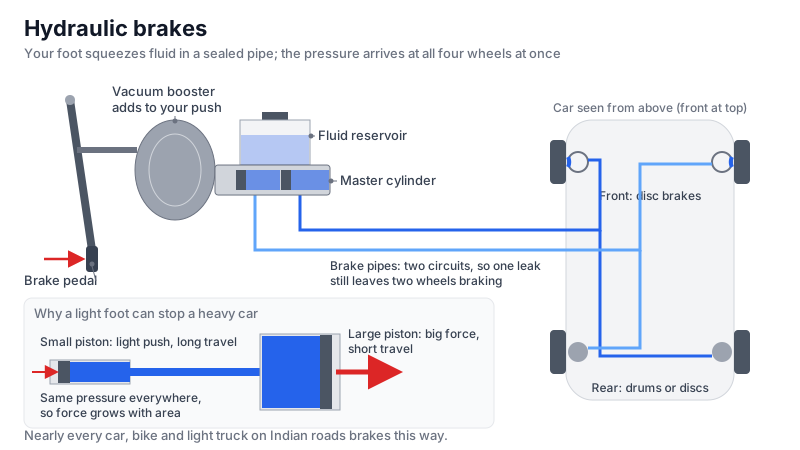
Pedal, booster and master cylinder feeding two brake circuits; the inset shows why a small piston can move a large one with more force 
Section through a tandem master cylinder: two pistons, two circuits and the fluid reservoir on topPhoto: Fred the Oyster · CC BY-SA 4.0 · Commons Animated walk-through of a brake master cylinderVideo: Thomas Schwenke
How it works
Almost every car, two-wheeler and light truck sold in India stops with hydraulic brakes. Instead of rods or cables, a liquid carries your effort from the pedal (or lever) to the wheels. Brake fluid cannot be squeezed smaller, so pressure applied at one end of a sealed pipe appears at the other end straight away, and equally at every wheel.
- You press the pedal; a lever and, in most cars, a vacuum booster multiply the push.
- The pedal moves a piston inside the master cylinder, raising the pressure of the fluid.
- Steel pipes and short flexible hoses carry that pressure to each wheel.
- At the wheel, a caliper piston (disc brake) or wheel cylinder (drum brake) is pushed out, pressing friction material against the spinning disc or drum.
- Release the pedal and springs and seals pull everything back, and the fluid returns.
The clever part is Pascal's principle: pressure is the same everywhere in the fluid, so force depends on piston area. The master cylinder piston is small and the wheel pistons are large, which is why a light foot can stop a heavy car. Cars use a tandem master cylinder with two separate circuits, usually split diagonally, so a leak in one still leaves two wheels braking. Motorcycles have a small master cylinder on the handlebar for the front brake and another by the right footpeg for the rear.
What you notice is a firm, progressive pedal. A spongy pedal usually means air or old, moisture-laden fluid in the system, which is why the fluid is replaced at the interval in the service schedule.
Pros
- Light pedal or lever effort thanks to force multiplication
- Equal pressure at every wheel, so braking is balanced
- Few moving parts and little to adjust
- Self-adjusting when paired with disc brakes
Cons
- Fluid absorbs moisture and must be replaced on schedule
- Air in the lines makes the pedal spongy
- A leak loses pressure in that circuit
- Not strong enough on its own for heavy trucks
Vehicles with this component
6 models on sale or coming. The note after the price is what the spec sheet says about this component; a variant name in brackets means only that trim brings it.
Trucks & Commercial 6
 Eicher Trucks & Buses Pro 2049₹10 lakh – ₹12 lakhPhoto: Shadman Samee from Dhaka, Bangladesh · CC BY-SA 2.0 · Wikimedia CommonsLaunched 1 Apr 2020launched
- Force Motors Monobus₹27.63 lakhLaunched 1 Jan 2021launched
