Air brakes
BrakesHeavy trucks and buses brake with compressed air: a compressor fills tanks, and the pedal meters that air to chambers that push the brakes on.
Found on: Trucks
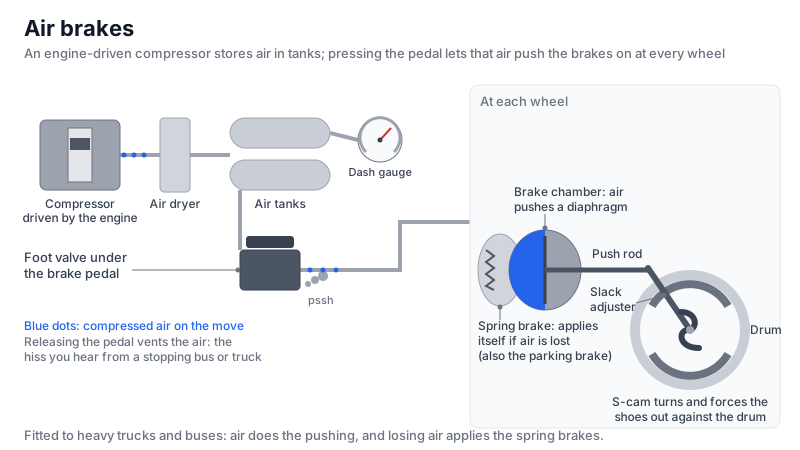
Compressor, dryer and tanks feed the foot valve; at each wheel a brake chamber pushes a slack adjuster that turns the S-cam and spreads the shoes 
A truck brake chamber with its spring-brake section: the service diaphragm is in the lower half, the parking spring in the upper canPhoto: Panoha · CC BY-SA 3.0 · Commons An introduction to how truck air brakes workVideo: Educational Mechanics
How it works
A loaded truck weighs many times what a car does, and a driver's leg cannot squeeze brake fluid hard enough to stop it. Air brakes solve this by using engine power to do the pushing. Every heavy truck and bus on Indian highways, from a Tata Prima or Ashok Leyland tractor to a BharatBenz tipper, uses them.
An engine-driven compressor pumps air through a dryer into storage tanks on the chassis. A gauge on the dash shows the tank pressure and a buzzer warns if it drops too low; a driver waits for the pressure to build before moving off.
- Pressing the pedal opens a foot valve that releases stored air in proportion to how hard you push.
- Air flows through pipes to a brake chamber at each wheel, where it pushes a rubber diaphragm.
- The diaphragm pushes a rod and a lever, the slack adjuster, which turns an S-shaped cam.
- The cam forces two shoes outward against the drum, exactly like a hydraulic drum brake but with air doing the work.
- Lift off and the chamber vents to the atmosphere: that loud hiss from a stopping bus.
Air brakes are fail-safe. A heavy spring inside each rear chamber is held off only by air pressure; if a pipe bursts or the tanks run down, the springs apply the brakes by themselves. The same spring is the parking brake, released by a knob on the dash. Trailers connect through the same system with a pair of coupling hoses. The downsides are a slight delay while air travels the length of the vehicle, a drum's tendency to fade on long descents (so trucks also use an exhaust brake) and more moving parts to keep sealed and adjusted.
Pros
- Enormous force, independent of driver effort
- Fail-safe: losing air applies the spring brakes
- Easy to couple to a trailer
- Air is free and a leak is not messy
Cons
- Slight lag between pedal and brakes
- Drum fade on long descents without an exhaust brake
- Compressor, dryer and valves need maintenance
- Must wait for pressure to build before moving off
Vehicles with this component
22 models on sale or coming. The note after the price is what the spec sheet says about this component; a variant name in brackets means only that trim brings it.
Trucks & Commercial 22
 BharatBenz 1217CPrice TBAPhoto: MarcelX42 · CC BY-SA 4.0 · Wikimedia CommonsLaunched 1 Apr 2020launched
- BharatBenz 1417RPrice TBAPhoto: MarcelX42 · CC BY-SA 4.0 · Wikimedia Commons


