Anti-lock braking system (ABS)
BrakesSensors watch each wheel and valves ease off the brake the instant one is about to lock, so you can keep steering while braking hard.
Found on: Cars · Trucks
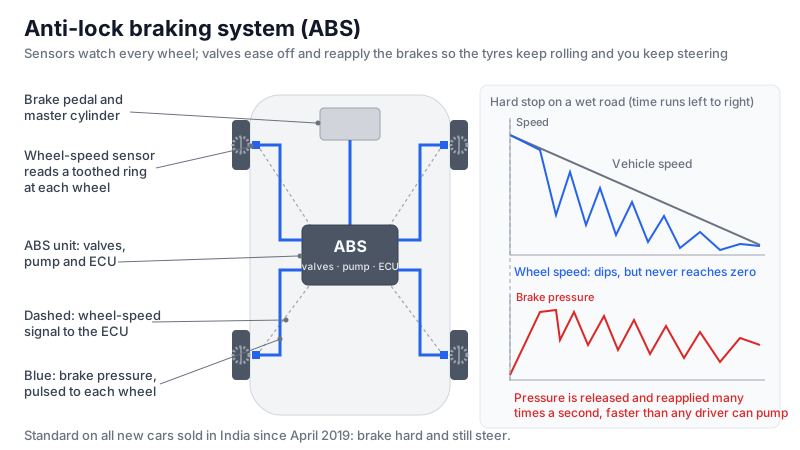
Sensors at each wheel feed the ABS unit between the master cylinder and the brakes; the chart shows wheel speed dipping but never reaching zero as pressure pulses 
An ABS hydraulic control unit opened up: the valve block with its solenoid valves and the pump motor armaturePhoto: Samf4u · CC BY-SA 4.0 · Commons Bosch India demonstrates ABS braking with and without the systemVideo: Bosch India
How it works
A locked wheel has no grip left for steering and, on most surfaces, stops the car more slowly than a wheel that is still just turning. ABS exists to keep the wheels on the edge of lock-up during a panic stop. Every new car sold in India has had it as standard since April 2019.
The hardware is a toothed ring and a speed sensor at each wheel, and a hydraulic unit, usually bolted in the engine bay, that sits between the master cylinder and the brake pipes. The unit holds a pair of solenoid valves per wheel, a small pump and an electronic control unit.
- The sensors report each wheel's speed many times a second.
- If one wheel slows far faster than the others, the ECU decides it is about to lock.
- An inlet valve closes to hold the pressure at that wheel, then an outlet valve opens to release some of it.
- The wheel speeds up and regains grip; the valves close and the pump pushes the pressure back up.
- The cycle repeats several times a second, for each wheel separately, until you lift off or the car stops.
In normal driving ABS does nothing; the valves are open and the pedal feels like any other. In a hard stop you feel a rapid pulsing through the pedal and may hear a buzz from the unit. That is the system working: keep your foot planted and steer. ABS shortens stopping distances on wet tarmac but not necessarily on loose gravel or snow, where a locked wheel can plough up a wedge of material. The same sensors and valves are the foundation for electronic brake-force distribution and stability control. Two-wheelers use the same idea in single-channel and dual-channel form.
Pros
- Lets you steer during emergency braking
- Shorter stops on wet or uneven tarmac
- Stops a tyre flat-spotting in a panic stop
- Enables stability control and brake-force distribution
Cons
- Can lengthen stops on loose gravel or snow
- Pulsing pedal startles drivers who have never felt it
- Adds cost and a sensor at each wheel
- Cannot create grip that the tyre does not have
Vehicles with this component
146 models on sale or coming. The note after the price is what the spec sheet says about this component; a variant name in brackets means only that trim brings it.
Cars 146
 BMW 2 Series Gran Coupe₹45.3 lakh – ₹47.2 lakh · standard on all cars sold in India since April 2019Photo: Alexander Migl · CC BY-SA 4.0 · Wikimedia CommonsLaunched 17 Jul 2025launched
 BMW 3 Series Gran Limousine₹60.45 lakh – ₹61.75 lakh · standard on all cars sold in India since April 2019Photo: LuvsMG481 · CC BY-SA 4.0 · Wikimedia Commons


