Drum brake
BrakesTwo curved shoes inside a drum that turns with the wheel are pushed outward against its inner surface to slow it down.
Found on: Cars · Motorcycles · Scooters · Trucks
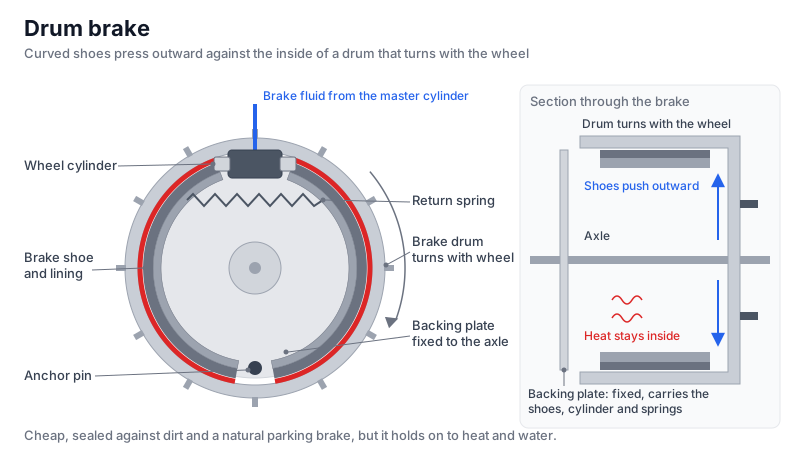
Drum with its face removed: shoes, wheel cylinder, return spring and anchor pin; the section shows how the drum encloses the shoes 
Rear drum brake with the drum pulled off: shoes, wheel cylinder at the top, springs and the hub with its wheel studsPhoto: ProjectManhattan · CC BY-SA 3.0 · Commons Drum brakes explainedVideo: Engineering Explained
How it works
The drum brake is the older, cheaper design still fitted to the rear wheels of most Indian hatchbacks and commuter bikes, to many scooters, and to almost every truck axle. A cast-iron drum, shaped like a shallow cup, is bolted to the hub and spins with the wheel. Inside it sits a backing plate fixed to the axle, carrying two curved brake shoes lined with friction material, a hydraulic wheel cylinder at the top and return springs.
- Fluid pressure (or a cable on many bikes and scooters) pushes the two pistons of the wheel cylinder outward.
- Each piston pushes the top of a shoe outward; the shoes pivot on an anchor pin at the bottom.
- The linings press against the inside of the spinning drum and friction slows it.
- The leading shoe is dragged harder into the drum by the drum's own rotation, a self-energising effect that adds braking force for free.
- Release the pedal and the return springs pull the shoes back off the drum.
Because the drum encloses everything, dirt and water stay out, but heat stays in. On a long downhill run the drum expands and the linings fade, which is why drums are kept to the rear of cars, or paired with an exhaust brake on trucks. A simple lever or cable can apply the same shoes, so the drum doubles as the handbrake without extra parts.
What you notice is a brake that needs little attention and is cheap to reline, but one that can feel wooden after a drenching or after hard use, and that sometimes needs adjusting as the linings wear.
Pros
- Cheap to make and to reline
- Sealed against dirt and water
- Self-energising, so less effort is needed
- Doubles as a parking brake
Cons
- Traps heat, so it fades on long descents
- Slow to recover after driving through water
- May need periodic adjustment
- Heavier than a disc of the same capacity
Vehicles with this component
60 models on sale or coming. The note after the price is what the spec sheet says about this component; a variant name in brackets means only that trim brings it.
Cars 19
 Honda Cars Amaze₹7.65 lakh · rearPhoto: Ashwin's Garage · CC BY 3.0 · Wikimedia CommonsLaunched 1 Dec 2024launched
 Honda Cars Amaze 2nd Gen₹6.98 lakh · rearPhoto: Sherwin · CC BY-SA 4.0 · Wikimedia Commons


