Truck axle configuration
DrivetrainThe 4x2, 6x2, 6x4, 8x2 or 8x4 code on a truck: total wheel positions by the number that are driven.
Found on: Trucks
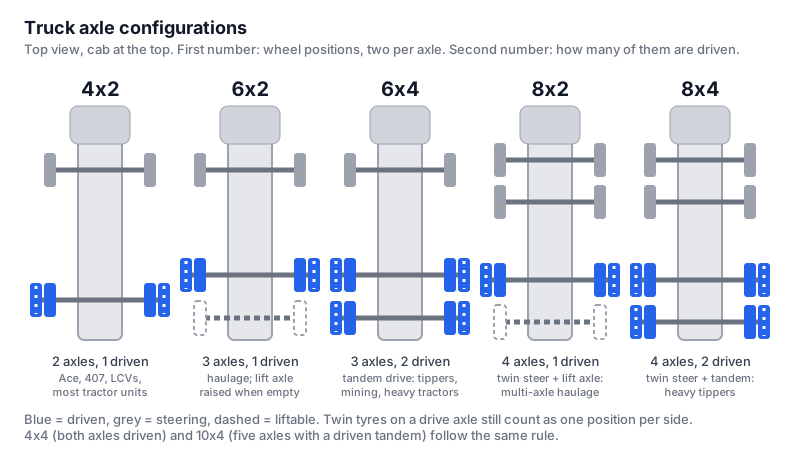
Five chassis side by side: 4x2, 6x2, 6x4, 8x2 and 8x4 with steer, driven and lift axles marked. 
Tandem driven rear axles of a 6x4 truck.Photo: Panoha · CC BY-SA 3.0 · Commons Truck Tropia decodes 4x2, 6x4, 8x4 and other truck axle configurations.Video: Truck Tropia
How it works
Commercial vehicles are described by a two-number code such as 6x4. The first number counts wheel positions, two per axle, with a pair of twin tyres counted as one position. The second number counts how many of those positions are driven. So a 6x4 has three axles (six positions) and four driven positions, meaning two driven rear axles.
- 4x2: two axles, one steering at the front and one driven at the rear. This is the Tata Ace, the 407, most LCVs and intermediate trucks, and most tractor units for ordinary trailers.
- 6x2: three axles, only one driven. The third axle is a load-carrying lift axle that is raised when the truck runs empty to save tyres and fuel. Common on 25-tonne haulage trucks.
- 6x4: three axles with a tandem pair of driven rear axles. The extra traction suits tippers in mines and construction, and heavy tractor units pulling 40 tonnes and more, such as the BharatBenz 2826C.
- 8x2: four axles, twin steering axles at the front, one driven and one lift axle at the rear. The typical 35-tonne multi-axle haulage truck.
- 8x4: four axles with twin steer and a driven tandem, for heavy tippers and construction trucks such as the Tata Prima 3530.K.
- 4x4 and 10x4 follow the same rule: all four positions driven on an off-road LCV, or five axles with a driven tandem on the heaviest rigid trucks.
Driven axles are heavier and cost more to buy and to run, so operators choose the fewest that will give the traction and legal axle loads the job needs. The configuration also decides how much the truck may legally carry, because each axle has a maximum permitted load.
Pros
- More driven axles mean more traction on sites and gradients
- Lift axles cut tyre wear and fuel when running empty
- Twin-steer layouts spread heavy loads legally over more axles
Cons
- Each driven axle adds weight, cost and fuel consumption
- More axles mean more tyres and brakes to maintain
- Longer multi-axle trucks need more room to turn
Vehicles with this component
3 models on sale or coming. The note after the price is what the spec sheet says about this component; a variant name in brackets means only that trim brings it.
Trucks & Commercial 3
- BharatBenz 5528TPrice TBA · 4x2Launched 1 Jan 2021launched
 Mahindra Blazo X 55Price TBA · 4x2Photo: Bhaleraomkar · CC BY-SA 4.0 · Wikimedia CommonsLaunched 1 Dec 2019launched
