Front-wheel drive
DrivetrainThe engine drives the front wheels, with engine, gearbox and differential packed together over the front axle; the layout of most Indian cars.
Found on: Cars
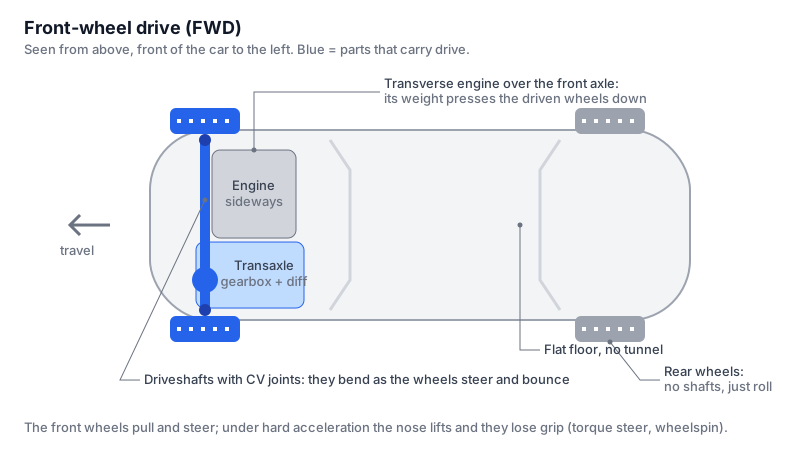
Top view: transverse engine and transaxle over the front axle, driveshafts to the front wheels, rear wheels free. 
Diagram of a transverse engine, transaxle and driveshafts in a front-wheel-drive car.Photo: Hoikka1 · CC BY-SA 3.0 · Commons Engineering Explained on front-wheel drive.Video: Engineering Explained
How it works
In a front-wheel-drive car the engine is usually mounted sideways across the nose, with the gearbox bolted to one end of it. The gearbox and the differential share one casing, called a transaxle, so the whole powertrain sits in a compact block between the front wheels.
- Engine torque enters the transaxle, passes through the gears, and arrives at the differential, which lets the two front wheels turn at different speeds in corners.
- From the differential, two short driveshafts run out to the front hubs.
- Each driveshaft has a constant-velocity (CV) joint at both ends, so it can bend as the wheel steers and bounces while still turning smoothly. The rubber boots over these joints are a common service item.
- The front wheels therefore do two jobs at once: they pull the car along and they steer it.
Nothing mechanical runs to the rear, so the floor is flat, the boot is deep and the car is lighter and cheaper to build. The engine's weight over the driven wheels also gives good traction on wet roads.
What you notice: predictable, nose-led handling that tends to run wide (understeer) if you enter a corner too fast, which is easy to manage by lifting off. Under hard acceleration the nose lifts and the front tyres can spin or tug the steering, especially in powerful turbo cars, and a heavily loaded boot takes weight off the driven wheels. Hatchbacks and sedans such as the Swift, Baleno, i20, City and Verna, and compact SUVs such as the Creta, Nexon and Brezza, are all front-wheel drive.
Pros
- Cheapest and lightest layout; flat floor and a big boot
- Good wet-road traction with the engine weight over the driven wheels
- Easy, forgiving handling for everyday driving
Cons
- Traction limited under hard acceleration; torque steer in powerful cars
- Heavy nose and understeer when pushed
- Front tyres and CV boots wear faster since they steer and drive
Vehicles with this component
3 models on sale or coming. The note after the price is what the spec sheet says about this component; a variant name in brackets means only that trim brings it.
Cars 3
 Lexus ES 350h₹66.1 lakh – ₹71.8 lakhPhoto: Alexander Migl · CC BY-SA 4.0 · Wikimedia CommonsLaunched 1 Sept 2025launched
 Maruti Suzuki XL6₹11.62 lakh – ₹14.68 lakhPhoto: Agratsa · CC BY-SA 4.0 · Wikimedia Commons