All-wheel drive
DrivetrainA system that can drive all four wheels automatically, usually adding a clutch-controlled rear axle to a front-wheel-drive car for extra grip.
Found on: Cars
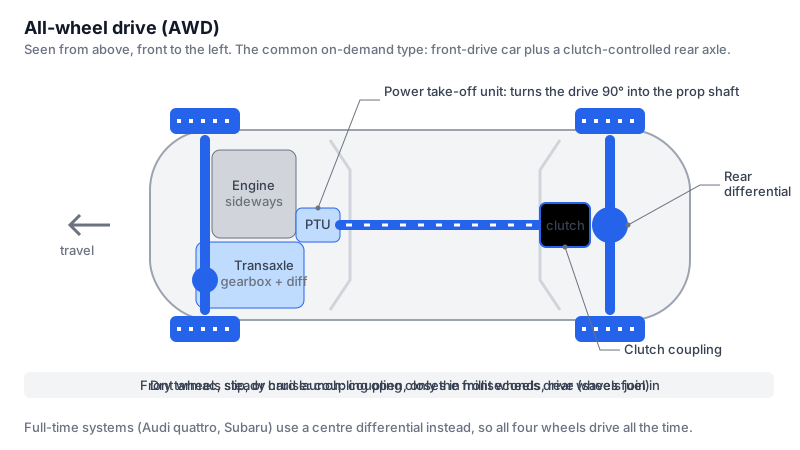
Top view of an on-demand system: power take-off, propeller shaft and the clutch coupling that brings the rear axle in when needed. 
Torsen centre differential from an Audi quattro system.Photo: NocturnalA6 2.7 · CC BY-SA 4.0 · Commons Engineering Explained on all-wheel-drive systems.Video: Engineering Explained
How it works
All-wheel drive sends torque to all four wheels without the driver having to select anything. The most common form on Indian SUVs starts with a front-wheel-drive layout and adds a route to the rear.
- A power take-off unit on the transaxle turns the drive through 90 degrees into a propeller shaft running to the rear axle.
- Just ahead of the rear differential sits a multi-plate clutch coupling in an oil bath.
- In normal driving the coupling is open or lightly loaded and the car runs on its front wheels alone, which saves fuel.
- When the control unit sees the front wheels start to spin, or detects a hard launch, a steep incline or a chosen drive mode, it squeezes the clutch plates in milliseconds and the rear wheels join in. The split between the axles varies continuously.
Because the coupling can slip, the system can stay engaged on dry tarmac without binding in corners, unlike a part-time 4x4. Full-time systems such as Audi's quattro take a different route: a centre differential, often a Torsen, splits torque permanently between both axles. Electric cars get all-wheel drive more simply still, with a second motor on the other axle and no shafts at all, as in the Kia EV6 and BYD Sealion 7.
What you notice: nothing, most of the time, which is the point. On a wet ghat road, a muddy track to a farmhouse or a slushy climb you get traction without touching a switch. The cost is extra hardware and weight, slightly higher fuel use and price, and usually no low range, so it is for grip, not for serious rock crawling. The Grand Vitara and Hyryder AllGrip, XUV700 AWD and Skoda Kodiaq 4x4 are typical.
Pros
- Automatic traction on wet, muddy or loose roads with no driver input
- Stable, confident cornering in bad weather
- Can be used on tarmac all the time, unlike part-time 4x4
Cons
- Extra weight, cost and fuel consumption
- Usually no low-range gearing or locking differentials for serious off-roading
- On-demand couplings can overheat in prolonged slipping
Vehicles with this component
6 models on sale or coming. The note after the price is what the spec sheet says about this component; a variant name in brackets means only that trim brings it.
Cars 6
 Kia EV9₹1.3 crorePhoto: Calreyn88 · CC BY-SA 4.0 · Wikimedia CommonsLaunched 1 Oct 2024launched
 Lexus NX 350h₹67.93 lakh – ₹74.88 lakhPhoto: Captainmorlypogi1959 · CC BY-SA 4.0 · Wikimedia CommonsLaunched 1 Mar 2022


