Manual gearbox
TransmissionA gearbox where the driver selects each ratio with a lever and a clutch pedal, the default on most Indian cars and trucks.
Found on: Cars · Trucks
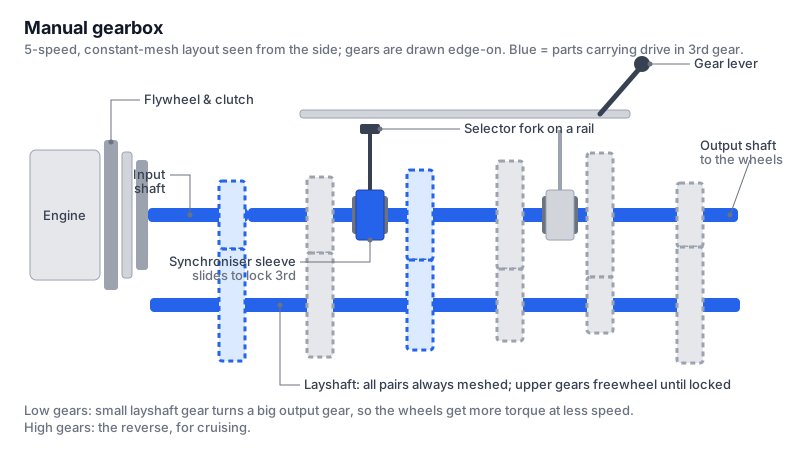
Side view of a 5-speed manual: input shaft, layshaft and output shaft, with the synchroniser sleeve sliding to lock 3rd gear. 
A five-speed car gearbox with the casing off: input and output shafts, gear pairs, synchroniser hubs and selector rods.Photo: Oldřich Lebeda · CC BY-SA 3.0 · Commons Engineering Explained walks through how a manual transmission works.Video: Engineering Explained
How it works
A manual gearbox is a box of gear pairs between the engine and the driven wheels. Each pair gives a different ratio: low gears let the engine spin fast while the wheels turn slowly, which multiplies torque for pulling away and climbing; high gears do the opposite for economical cruising. The driver chooses the ratio with the gear lever and uses the clutch pedal to disconnect the engine while changing.
Almost every modern manual is a constant-mesh design: all the gear pairs are permanently meshed, with the gears on the output shaft free to spin on bearings. Selecting a gear does not move the gears themselves; it slides a collar that locks one gear to the shaft.
- Press the clutch: the clutch plate separates from the flywheel and the input shaft stops receiving torque.
- Move the lever: a selector fork pushes a synchroniser sleeve towards the chosen gear.
- The synchroniser's brass cone rubs against the gear and matches its speed, so the dog teeth slide in without crunching.
- Release the clutch: torque flows from the input shaft, through the layshaft and the locked gear pair, to the output shaft and on to the differential.
The box is bolted to the back of the engine. In a front-wheel-drive hatchback such as the Swift it is a transaxle beside the transverse engine; in a Fortuner or a Tata truck it sits behind a lengthways engine with a propeller shaft to the rear axle. Trucks use the same idea with more ratios, often six to nine, sometimes with a splitter that doubles them.
What you notice: a direct, mechanical connection, the need to co-ordinate clutch and throttle at every stop, and the cheapest purchase and running cost of any transmission type.
Pros
- Cheapest to buy and repair, and the lightest option
- Direct control: you choose the gear for the hill, the overtake or the traffic
- Usually the most fuel-efficient choice in a given model
- Simple, long-lived mechanics with few electronics
Cons
- Clutch work is tiring in stop-go city traffic
- The clutch plate is a wear item, more so with heavy loads or rough use
- Takes practice: stalls and jerky starts for new drivers
Vehicles with this component
73 models on sale or coming. The note after the price is what the spec sheet says about this component; a variant name in brackets means only that trim brings it.
Cars 73
- Citroen AircrossXPrice TBALaunched 1 Oct 2023launched
 Citroen BasaltXPrice TBAPhoto: Gpkp · CC BY-SA 4.0 · Wikimedia CommonsLaunched 1 Aug 2024launched


