Continuously variable transmission (CVT)
TransmissionA belt-and-pulley transmission that changes its ratio smoothly and continuously, so the engine can stay at its most efficient speed.
Found on: Cars
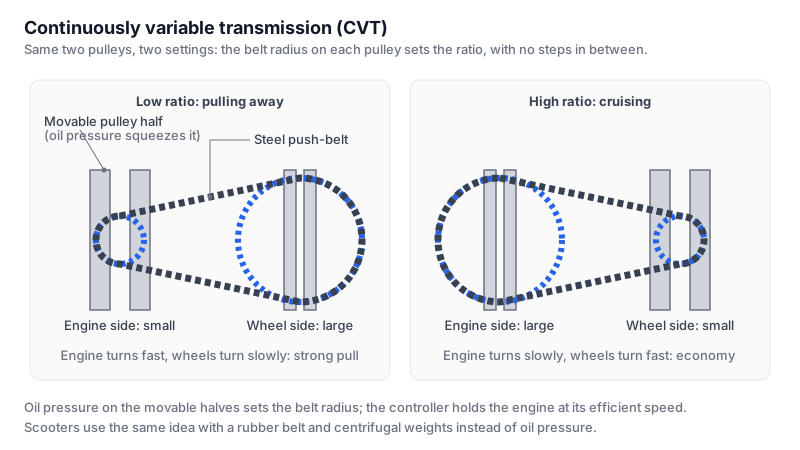
The same two pulleys at low ratio (pulling away) and high ratio (cruising), showing how the belt radius changes. 
Cutaway of a Toyota steel-belt CVT: the two variable pulleys and the push-belt between them.Photo: Hatsukari715 · Public domain · Commons Engineering Explained on how a CVT varies its ratio.Video: Engineering Explained
How it works
A CVT has no fixed gears. Instead it uses two V-shaped pulleys joined by a steel push-belt (or, in some designs, a chain). Each pulley is made of two cone-shaped halves that can be squeezed together or moved apart by hydraulic pressure. Squeezing the halves pushes the belt outwards to ride on a larger radius; letting them apart drops it inwards.
- Pulling away: the engine-side pulley is open (belt at a small radius) and the wheel-side pulley is closed (belt at a large radius). The engine spins fast while the wheels turn slowly, which is a low ratio with plenty of pull.
- As speed builds, the controller squeezes the engine-side pulley and releases the wheel-side one. The ratio rises steadily, with no steps.
- Cruising: the belt sits large on the engine side and small on the wheel side, like a tall overdrive gear.
A small torque converter or a clutch pack handles the stop and the creep, and a planetary gear gives reverse. The whole unit lives where a normal gearbox would, beside the transverse engine.
What you notice: seamless acceleration with the engine held at a constant note, sometimes a drone, because the ratio is doing the changing rather than the revs. Many cars fake stepped gears in Sport mode so it feels more familiar. Honda's CVT in the City and Amaze, Hyundai's IVT in the Creta and Nissan's X-Tronic in the Magnite are all steel-belt CVTs.
Toyota's e-CVT in the Hyryder and Innova Hycross hybrids is a different device, a planetary gearset blending engine and motor power, that happens to share the name.
Pros
- Smooth, step-free acceleration and refined low-speed manners
- Keeps the engine at its efficient speed, so it does well on economy
- Fewer parts than a conventional automatic, and compact
Cons
- Rubber-band feel and engine drone when you ask for full power
- Belt and pulleys limit torque, so it suits small and mid-size engines
- Repairs can be expensive; the unit is usually replaced rather than rebuilt
Vehicles with this component
11 models on sale or coming. The note after the price is what the spec sheet says about this component; a variant name in brackets means only that trim brings it.
Cars 11
 Honda Cars City(e:HEV ZX, V CVT variants)₹12 lakhPhoto: Dairokkan9 · CC BY-SA 4.0 · Wikimedia CommonsLaunched 2 Mar 2023launched
 Honda Cars ZR-V₹50 lakhPhoto: Calreyn88 · CC BY-SA 4.0 · Wikimedia Commons


