Hub motor
TransmissionAn electric motor built into the wheel itself: a fixed stator on the axle with the wheel rim rotating around it as the rotor.
Found on: Scooters · Motorcycles
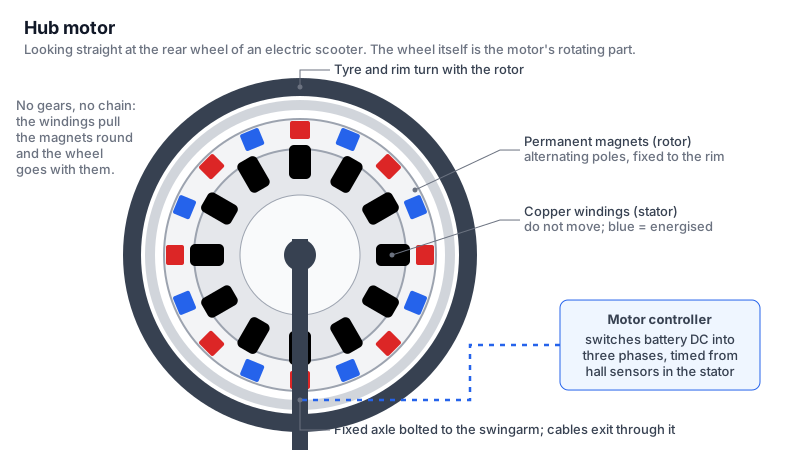
Looking at a rear wheel: fixed stator windings on the axle, magnets on the rotor turning with the rim, and the controller feeding three phases. 
A small hub motor opened up: copper stator windings inside, magnet ring and tyre outside.Photo: Andrez1 · CC BY-SA 4.0 · Commons JAES Company explains how a brushless motor works, the principle behind hub motors.Video: JAES Company
How it works
A hub motor puts the motor where the wheel is, so there is no chain, belt or gearbox at all. Most electric scooters in India, including the TVS iQube and Honda QC1, use one in the rear wheel.
- The stator, a ring of iron teeth wound with copper coils, is fixed to the axle, which is bolted to the swingarm and does not turn.
- Around it sits the rotor, a ring of permanent magnets fixed to the wheel hub. The rim and tyre are bolted to that hub, so the wheel is the rotating part of the motor.
- The motor controller takes DC from the battery and switches it into three phases, energising the coils in sequence so their magnetic field rotates.
- The magnets chase that rotating field, dragging the wheel round with them. Hall sensors in the stator tell the controller exactly where the magnets are, so it times each pulse correctly.
- Lift off and the same magnets passing the coils generate electricity instead, giving regenerative braking back into the battery.
Both brushless DC (BLDC) and permanent-magnet synchronous (PMSM) hub motors work this way; the difference is how the controller shapes the current. Power and sensor cables exit through the hollow axle.
What you notice: silent, direct drive with instant response and nothing to adjust or lubricate. The motor adds a few kilograms of unsprung weight to the wheel, which the suspension has to manage over potholes, and because there is no reduction gearing the motor must make its full torque directly, so it is larger and heavier than a geared mid-drive motor of the same power. Heat is also harder to shed from inside a wheel, which limits sustained hill climbing on cheaper designs.
Pros
- Simplest possible drivetrain: no chain, belt or gears to service
- Silent and efficient at steady speeds; easy regenerative braking
- Frees up frame space for the battery and boot
Cons
- Unsprung weight in the wheel hurts ride and handling over bad roads
- Cooling is difficult; sustained climbs can trigger power cut-back
- Wheel removal for a puncture is more involved; motor replacement is costly
Vehicles with this component
2 models on sale or coming. The note after the price is what the spec sheet says about this component; a variant name in brackets means only that trim brings it.
Scooters 2
- Honda Motorcycle & Scooter India QC1₹90,708Launched 1 Jan 2025launched
- TVS Motor iQube₹95,000 – ₹1.6 lakhLaunched 1 May 2024launched