Belt final drive
TransmissionA toothed rubber belt with tensile cords in place of a chain: quiet and maintenance-free, used on cruisers and many electric scooters.
Found on: Motorcycles · Scooters
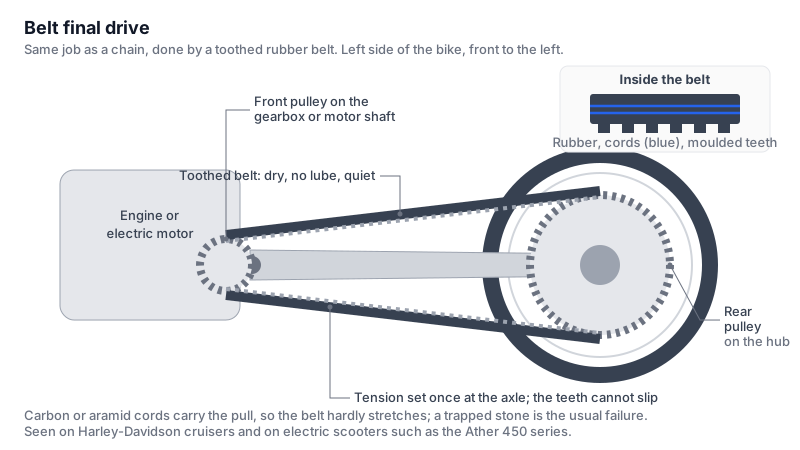
Toothed belt between front and rear pulleys, with a cross-section showing the tensile cords. 
Toothed drive belt on the rear pulley of a Harley-Davidson V-Rod.Photo: Piero · CC BY-SA 3.0 · Commons MC Garage compares chain, belt and shaft final drives.Video: Motorcyclist Magazine
How it works
A belt final drive does the same job as a chain, linking a front pulley on the gearbox or motor to a large pulley on the rear wheel, but with a toothed belt instead of metal links. The belt is a flat rubber band with moulded teeth on the inside face that mesh with teeth on both pulleys, so, unlike a V-belt, it cannot slip. Inside the rubber run cords of carbon fibre or aramid that carry the pull and keep the belt from stretching.
- The front pulley turns, its teeth push on the belt teeth, and the belt turns the rear pulley.
- The reduction is set by the pulley tooth counts, just as with sprockets.
- The belt is tensioned once at the axle adjusters and then largely left alone; because the cords do not stretch, it holds its tension for tens of thousands of kilometres.
- Nothing needs oil. A rinse with water and an occasional check for cuts or embedded stones is the whole service routine.
Belts are wider than chains and need a clean, straight run, so they appear where there is room and the rider values quiet: Harley-Davidson's cruisers and touring bikes, and electric scooters such as the Ather 450 series, whose mid-mounted motor drives the rear wheel through a belt. Many hub-motor scooters have no final drive at all.
What you notice: silence and smoothness, no oily rear wheel and no adjustment chores. The trade-offs are that a belt cannot be shortened or joined by the roadside, a stone trapped between belt and pulley can cut it, and changing the gearing means new pulleys, not a cheap sprocket.
Pros
- Quiet, smooth and clean: no lubrication at all
- Very long life with almost no adjustment
- Lighter than a shaft, with no snatch in the drive
Cons
- A trapped stone or a cut can finish the belt; no roadside repair
- Wider than a chain and needs precise pulley alignment
- Gearing changes mean new pulleys and often a new belt
Vehicles with this component
No model in the catalog is mapped to this component yet.