Monocoque body
ChassisThe body shell itself is the structure: floor, sills, pillars and roof are welded into one unit that carries the engine, suspension and passengers.
Found on: Cars · Trucks
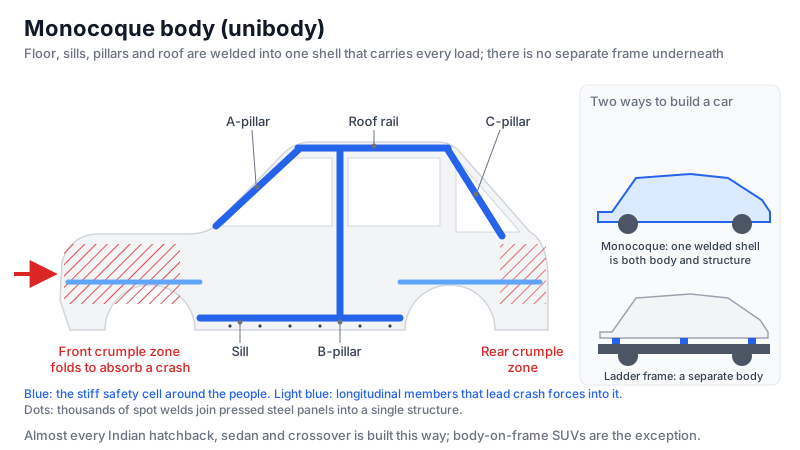
Side view of a hatchback shell with the safety cell highlighted and the crumple zones hatched; the inset compares it with a body on a separate frame 
A bare Smart body shell on its wheels: the welded cell of pillars, sills and floor is the car's whole structurePhoto: KarleHorn · CC BY-SA 3.0 · Commons Unibody versus body-on-frame: which is best?Video: Engineering Explained
How it works
Almost every Indian hatchback, sedan and crossover, from the Alto to the Creta and the XUV700, is a monocoque (also called unibody). There is no separate frame underneath. Hundreds of pressed steel panels are spot-welded into a single shell, and that shell carries every load: the weight of the engine, the forces from the suspension, the twisting on a rough road and the crash energy in an accident.
Strength comes from shape, not thickness. The sills along the door bottoms, the pillars, the roof rails, the floor cross-members and the front and rear longitudinal members are all box sections, thin steel folded into closed tubes that are very stiff for their weight. In the engine bay a subframe, bolted to the shell, carries the engine and the lower suspension arms.
- Panels are stamped from sheets of steel of different grades; the safety cell uses high-strength steel, the crumple zones softer grades.
- Robots weld them into a bare shell, the body-in-white, which is then painted and fitted out.
- In a crash the front or rear members fold in a planned way, absorbing energy over a longer distance.
- The passenger cell around the people stays rigid.
- Suspension, engine and subframes bolt to reinforced mounting points in the shell.
The result is lighter and stiffer than a body sitting on a frame, which helps fuel economy, handling and crash scores alike; it also allows a flat, low floor. The trade-offs are that heavy off-road abuse or a bad crash can bend the shell itself, which is harder to repair than swapping a frame section, and that a monocoque cannot easily take a different body on the same underpinnings. That is why pickups and the toughest SUVs still use a ladder frame.
Pros
- Lighter and stiffer than body-on-frame
- Better crash protection through designed crumple zones
- Lower floor and more cabin space
- Sharper handling and better fuel economy
Cons
- Serious crash damage can distort the whole shell
- Less tolerant of heavy off-road abuse and overloading
- Harder to adapt to different body styles
- Repairs need jigs and skilled panel work
Vehicles with this component
7 models on sale or coming. The note after the price is what the spec sheet says about this component; a variant name in brackets means only that trim brings it.
Trucks & Commercial 7
- Force Motors e-TravellerPrice TBALaunched 1 Jan 2025launched
- Force Motors Monobus₹27.63 lakhLaunched 1 Jan 2021launched

