Ladder-frame chassis
ChassisTwo long steel rails joined by cross members form a separate frame; the body, engine and axles all bolt onto it.
Found on: Cars · Trucks
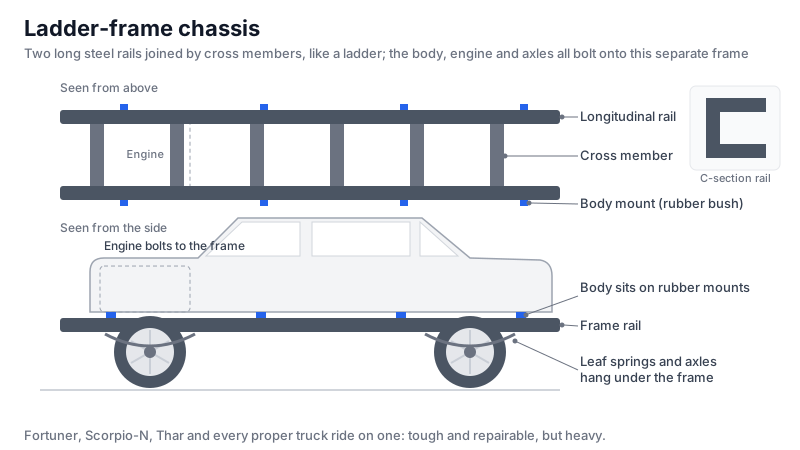
Plan view of the rails and cross members, and a side view of the body sitting on rubber mounts above the frame with the axles hung underneath 
A bare galvanised Land Rover ladder frame: two long rails, cross members and the brackets everything else bolts toPhoto: Lewis Collard · Public domain · Commons OVERDRIVE on the different types of vehicle chassisVideo: OVERDRIVE
How it works
Look under a Fortuner, a Scorpio-N, a Thar or any truck and you will see the ladder frame: two long rails of pressed steel, usually C-shaped in section, running the length of the vehicle and joined by cross members like the rungs of a ladder. Everything else is bolted to this frame. The engine and gearbox sit between the rails on rubber mounts, the axles hang below it on leaf springs or coil springs, and the body is a separate shell that sits on rubber bushes along the top.
Because the frame does all the structural work, the body can be almost anything: an SUV cabin, a pickup bed, a tipper body, a bus. That is why truck makers sell a bare chassis-cab and let a body builder finish it.
- The rails are rolled or pressed from thick steel and joined by riveted or welded cross members.
- Engine, gearbox, axles and suspension are mounted to brackets on the rails.
- The body is lowered on and bolted down through rubber bushes that absorb vibration.
- Loads from towing, carrying and rough roads pass through the rails, not the body.
- A damaged section of frame or body can be repaired or replaced on its own.
For the driver this means a vehicle that shrugs off overloading, rough tracks and towing, and that is cheap to repair after a knock. The costs are weight, a higher floor (you climb up into the cabin), a body that can shake a little on its mounts, and a frame that bends rather than crumples, so crash protection depends more on the body design. A monocoque is the lighter, more refined alternative used by most cars.
Pros
- Very strong for towing, loads and rough roads
- Easy to repair or re-body
- Handles overloading and off-road abuse
- Simple to build in many variants on one chassis
Cons
- Heavy, which hurts fuel economy
- High floor and tall step-in
- Less rigid, so the body can shake
- Crash energy is harder to manage than in a monocoque
Vehicles with this component
6 models on sale or coming. The note after the price is what the spec sheet says about this component; a variant name in brackets means only that trim brings it.
Cars 3
 Isuzu Motors India mu-XPrice TBAPhoto: Vogue2Voke · CC BY-SA 4.0 · Wikimedia CommonsLaunched 1 Aug 2021launched
- Mahindra Bolero Neo₹9.06 lakh – ₹10.85 lakhLaunched 1 Sept 2026launched

